
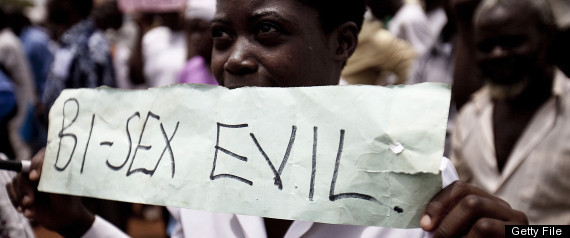
When I saw this now almost-iconic image of Ugandan anti-LGBT sentiment in a news report back in 2010, I didn’t notice at first that the text on the hand-drawn sign forged a pun: bi-sex evil = bisexevil = bisexual.
Bigot humour. How droll.
Actually, what I’d noticed first was the determined period or full-stop at the end of the words, as if what was scrawled on this sign was actually a sentence and what it had to say was the final word on the matter. But then I noticed the teenaged girl’s eyes.
I didn’t see hate in those eyes the first time I saw this photo. I still don’t. The girl seems muddled, seeking direction, not entirely in control of the hateful spirit in the note she holds. The paper partially obscures her face – her mouth, actually – as if she’s not sure of her own words, so she’s letting the sign speak for her. She doesn’t exhibit the wild-eyed rancour or grim-fisted visage I’ve seen in other photographs, though she is rather riveted to what I assume is a person speaking at some spot in the distance. A pulpit, maybe? The people behind her are blurred, but they are in relatively disciplined rows and the crisp, clean shirts in focus add to the feel that this is a ‘Sunday best’ environment. I’m going with that – church. And in reading this image further, I’m going with the narrative that this girl, seeking leadership from the pulpit, either picked up or scribbled this sign in an attempt to curry favour with the crowd around her, the people she came with, and most importantly the ‘leader’ in front of her on whom she fixes her eyes: Look at me. See what I have here. I’m listening to you. I have no mouth of my own, carve me one with your words. I will follow your lead.
Hate is taught. And she is learning.
Fundamentalist religion in Uganda, all across Africa and the world, is leading the battle to attack lesbian, gay, bisexual and transgender people, to deny them human rights, civil rights and even life. Home-grown Ugandan religious-based hatred is being buffeted by imported American evangelical Christians and their ’cures’ for what ails the non-heterosexual, non-gender-normative members of society. They begin by maliciously defining what LGBT people are: gay men are, by their definition, nothing but coprophagiacs and paedophiles; lesbians are mentally ill women pretending to be men and, as with the more highly publicised cases in South Africa, they can be cured by rape, often at the hands of relatives; transgender people are invaded by the spirits of dead people of opposite genders and can become victims of ‘crusades’ that use sexual and physical abuse to cleanse them; and bisexuals are recklessly predatory AIDS-carriers incapable of not forcing sexual relations with anyone in their sight and are thereby ‘evil’ – full-stop.
All LGBT people in Uganda live with the risk of shameless attacks on the street, in their homes, in churches, in sports facilities, anywhere someone chooses to shout out ‘there is one!’ and draw attention to them or, worse, cause an impromptu mob to attack. They risk loss of employment, mental and emotional abuse by strangers and loved ones alike, and often when they suffer from alcoholism, depression, suicidal thoughts, extreme stress, peer pressure, threats of divorce or relationship break-up, they cannot access appropriate psychological and health care, because that means having to out themselves and their partners to medical personnel.
When LGBT people complain about such treatment and the enormous pressure it places on their lives, the response from religious leaders, politicians, medical professionals, educators, and society at large: repent. Just stop your wicked ways.
Well, gay men cannot and should not be asked ‘to repent’, if that means to never love, never make love, or to forever live hiding in a soul-destroying closet. Lesbians cannot just ‘be discreet’, wear frilly dresses and avoid reading lesbian magazines, so as not to draw attention to themselves. Transgendered people cannot just forget their needs and feelings and happily subsume themselves in the gender assigned to them at birth, occasionally attending ceremonies to clean their spirits. And bisexuals cannot indiscriminately choose any partner of the opposite sex to hide behind just ‘because they can’ and forever deny their ability to love someone whatever their gender and all the personal, social, communal and political realities that come with having that orientation to life.
The prevalent accusation in the west that bisexuals can never be taken seriously in the fight for LGBT rights because they can always hide under ‘heterosexual privilege’, just choosing opposite sex partners (no matter whom they have actually fallen in love with) and eschewing their ‘gay side’ in order to avoid persecution – this is a moot point in Uganda, where the bisexual movement has risen to stand alongside other fellow LGBTI fighters for human rights. Bisexuals are visible and working for change. Ugandan LGBTI individuals do indeed have to hide much of themselves on a day-to-day basis to protect their lives and livelihoods, but as a group and a force, the LGBTI community of Uganda is one of the most visible, brave and determined the world has seen.
And because of the murder of teacher and activist David Kato, the highly publicised deportation case of asylum seeker Brenda Namigadde, and the threat of the death penalty for ‘aggravated homosexuality’ and same-sex relationships in Uganda, the world is beginning to take notice.
They deserve our support, not just in sentiment, but in donations to relevant activist groups, student organisations, churches and charities that help LGBT people, calls and emails to our political representatives, making our supportive voices heard in the media, and determining that no matter what sexual orientation we are that when we hear homophobic, biphobic or transphobic statements about people in Uganda (or anywhere in the world), that we speak up and let it be known that we do not adhere to such ideas and we will not tolerate hate around us. Each of us is just one voice, but our voices add up to change.
but still I can do something. I will not refuse
to do the something I can do.
~ Helen Keller


