Posted inbiphobia bisexuality english event family islam LGBTQ bangladesh mental health opinion porn project dhee public speaking roopbaan
Making Progress or Losing Ground: LGBT Asia
Being Bisexual: Navigating Invisibility & Practicality
 |
| Level 5 Function Room, Royal Festival Hall |
"I didn’t know the Bengali word for bisexual until I Googled it while I was at university. I didn’t actually even know the English word 'bisexual' until I was thirteen or so. Before then, I’d thought I was the weird gay kid who liked girls on the side.
I thought it would be good to start with some humour, but honestly I’m telling you this because it sets the tone for the rest of what I’m going to say, about how bisexuality is often not discussed or mentioned, or misunderstood.
I think bisexuals make many heterosexual and homosexual people uncomfortable - often because they’re confused by us. Maybe to an external monosexual observer, it can look like I’m pursuing men one day, and then the next day I flick a switch, become straight, and am pursuing women. And I guess this can be quite disconcerting, especially for a group of people who’ve built their activism around the slogan that sexual minorities do not choose to be attracted to who they’re attracted to.
I think their discomfort is misplaced though, as in reality I do not choose the gender I am attracted to - it just to so happens, because I’m attracted to more than one gender, that I’m able to choose the gender of the person I pursue. This is an important distinction to make, but perhaps a tricky one to wrap your head around unless you’re willing to have a full-on conversation about bisexuality.
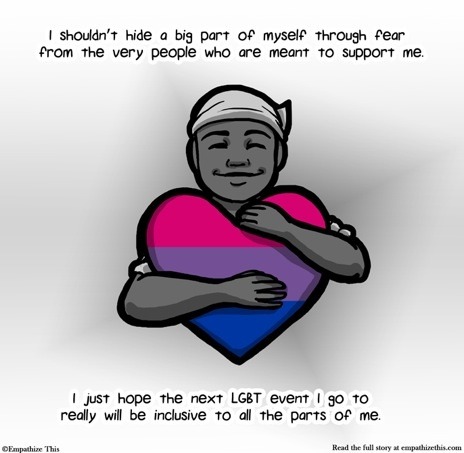
Of course, these dynamics can give rise to other potentially loaded questions. When I came out to my youngest aunt, one of the first things she asked was couldn’t I just date women? Wouldn’t that be both be safer and easier in Bangladeshi society? My answer was that I had tried to only date women, but doing that had meant I had to cut away and bury part of my identity - it was like I was pretending part of me was dead. She understood and could sympathise - and I think she was only trying to point out the practical.
But my answer isn’t the whole answer, as far bisexuality is concerned. What I described is just my experience as someone who is attracted quite strongly to men and women. But have a friend who, in her own words, is 'mostly straight'. She’s experimented with women but doesn’t feel as strongly about them as she does men. Her answer to my aunt’s question would probably have been quite different.
I come back to having full-on conversations. Communication is key - and talking to each other means we know where exactly we each stand. We all avoid making ignorant assumptions leading to uncomfortable situations. I’ve been asked by gay men if I’m just having fun with guys till I get married. I’ve also been asked by straight women if they’ll be enough for me - because they think physically they can’t offer me everything I want. Now the exact physicality of sexual intimacy isn’t that important to me, but the judgement is passed before I can say that. Popular culture doesn’t help - a bisexual is often someone who cheats, or bisexual porn as a genre is often about threesomes.
Apart from the presumed promiscuity, as a Bangladeshi I worry about the other misconceptions parents, family or society can have of sexual minorities. People often ask me if being Muslim complicates my situation. It does, but not necessarily in the way people think. The prevailing form of thought I have seen among folks across all demographics in Bangladesh is that they believe same-sex attractions are an illness, and condemnation manifests in various ways from this source. Islamic criticisms are but one of these manifestations. Of course, we need to have a rethink of why we interpret our religion without compassion for gender and sexual minorities. I know there are scholars who are working in this area now, and folks in the UK can go to organisations like Imaan or Safra as a first port of call. But in Bangladesh, I have atheist and humanist friends and family who aren’t fully comfortable with my sexuality either.
The root cause for a lot of this is ignorance. Things are getting better, however. We haven’t had any large scale movements, though you’ll be seeing photos behind me of a rainbow rally, which visibly includes hijras, held by Roopbaan, a newish group that promotes the freedom to love and brings out various LGBT publications. Their current profile picture on Facebook mentions biphobia, and the inclusion of bisexual factors in the conversation, something that is often missing with activism nowadays in the West, makes me happy. There’s also Project Dhee - which works to network and empower LGBT people themselves, most importantly including women, hijras and people from beyond just Dhaka. Obviously, poverty and literacy remain notable obstacles. Dhee is also successfully building allies from wider society, which shows people’s mindsets aren’t all stuck in the it’s-an-illness mode. I also know non-LGBT youth organisations are quietly gauging attitudes and educating, though I am unsure if they’re comfortable being named.
All said, the truth is Section 377 does hang over our heads. No case under it has ever made it to the Supreme Court but it’s also important to realise that 377 isn’t the only section of our penal code that can be used to stifle pro-LGBTQ action. And as with any big change affecting society, it’s important to note nowadays the state isn’t the only actor we should be wary of."
Thank you for reading. I spoke to a number of people following the event, and the content of the talk triggered some very interesting discussions. I've written a follow up piece this post, please click here if you're interested in reading the rest.
Of course, these dynamics can give rise to other potentially loaded questions. When I came out to my youngest aunt, one of the first things she asked was couldn’t I just date women? Wouldn’t that be both be safer and easier in Bangladeshi society? My answer was that I had tried to only date women, but doing that had meant I had to cut away and bury part of my identity - it was like I was pretending part of me was dead. She understood and could sympathise - and I think she was only trying to point out the practical.
But my answer isn’t the whole answer, as far bisexuality is concerned. What I described is just my experience as someone who is attracted quite strongly to men and women. But have a friend who, in her own words, is 'mostly straight'. She’s experimented with women but doesn’t feel as strongly about them as she does men. Her answer to my aunt’s question would probably have been quite different.
I come back to having full-on conversations. Communication is key - and talking to each other means we know where exactly we each stand. We all avoid making ignorant assumptions leading to uncomfortable situations. I’ve been asked by gay men if I’m just having fun with guys till I get married. I’ve also been asked by straight women if they’ll be enough for me - because they think physically they can’t offer me everything I want. Now the exact physicality of sexual intimacy isn’t that important to me, but the judgement is passed before I can say that. Popular culture doesn’t help - a bisexual is often someone who cheats, or bisexual porn as a genre is often about threesomes.
Apart from the presumed promiscuity, as a Bangladeshi I worry about the other misconceptions parents, family or society can have of sexual minorities. People often ask me if being Muslim complicates my situation. It does, but not necessarily in the way people think. The prevailing form of thought I have seen among folks across all demographics in Bangladesh is that they believe same-sex attractions are an illness, and condemnation manifests in various ways from this source. Islamic criticisms are but one of these manifestations. Of course, we need to have a rethink of why we interpret our religion without compassion for gender and sexual minorities. I know there are scholars who are working in this area now, and folks in the UK can go to organisations like Imaan or Safra as a first port of call. But in Bangladesh, I have atheist and humanist friends and family who aren’t fully comfortable with my sexuality either.
The root cause for a lot of this is ignorance. Things are getting better, however. We haven’t had any large scale movements, though you’ll be seeing photos behind me of a rainbow rally, which visibly includes hijras, held by Roopbaan, a newish group that promotes the freedom to love and brings out various LGBT publications. Their current profile picture on Facebook mentions biphobia, and the inclusion of bisexual factors in the conversation, something that is often missing with activism nowadays in the West, makes me happy. There’s also Project Dhee - which works to network and empower LGBT people themselves, most importantly including women, hijras and people from beyond just Dhaka. Obviously, poverty and literacy remain notable obstacles. Dhee is also successfully building allies from wider society, which shows people’s mindsets aren’t all stuck in the it’s-an-illness mode. I also know non-LGBT youth organisations are quietly gauging attitudes and educating, though I am unsure if they’re comfortable being named.
All said, the truth is Section 377 does hang over our heads. No case under it has ever made it to the Supreme Court but it’s also important to realise that 377 isn’t the only section of our penal code that can be used to stifle pro-LGBTQ action. And as with any big change affecting society, it’s important to note nowadays the state isn’t the only actor we should be wary of."
Thank you for reading. I spoke to a number of people following the event, and the content of the talk triggered some very interesting discussions. I've written a follow up piece this post, please click here if you're interested in reading the rest.