20th Century Bi – London’s bisexual history event
20th Century Bi – London’s bisexual history event


February is LGBT history month in the UK and - as promised last year, and the year before - this year there WILL be a specifically bi history event (I think there may even be two. More details at the end of this post).

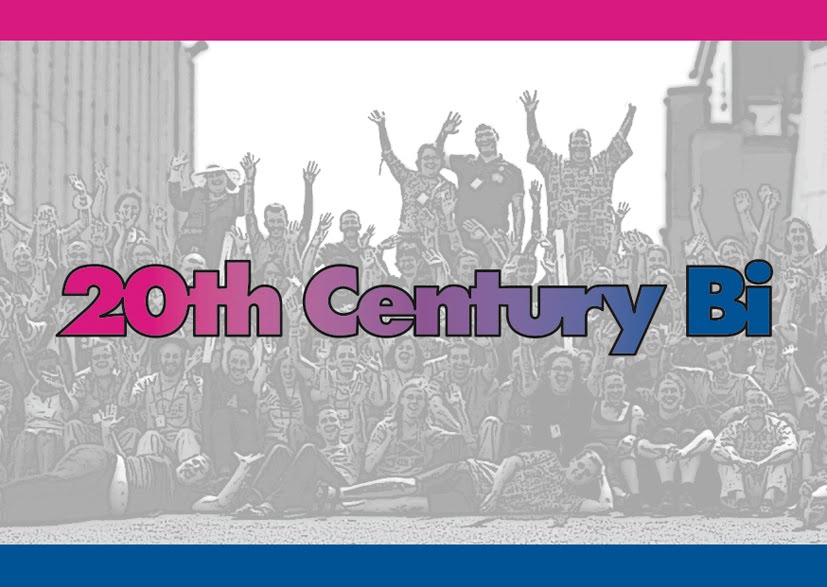
So... drum roll ... I am co-organising, and speaking at, an event in London called 20th century bi. (Great title, eh. Not my idea sadly, but that of my co-organiser Lisa Colledge.) Here's the details:

20th Century Bi
To mark the 30th anniversary of the bisexual community in the UK, this event will look at some of the big, bad, bold bis who made the 20th century great. A panel of speakers discusses 20th century bisexuals and bisexuality in Britain, as part of LGBT History Month.

Speakers are:

Sue George: Androgynous, ambisextrous, or “enjoying all life’s pleasures”: being bisexual before and after the sexual revolution

Christian Klesse: 'Re-writing the scripts of Love. The Critique of Monogamy, Polyamory and Bisexual Intimacies in the late 20th Century'

Lindsay River: Lesbian... or bisexual? The (mis)naming of creative women of the early 20th century

Ian Watters: Bisexuals at Pride: The somewhat partial story of bisexual involvement in the annual London Pride celebrations

Our individual talks will be followed by a panel discussion and Q&A.

Everyone is welcome to this bi-positive event.

Saturday 12 February 2011
2.30 - 4.30 pm

Conway Hall (Bertrand Russell Room)
25 Red Lion Square
London WC1R 4RL
(nearest tube is Holborn)

Tickets £5 (£3 unwaged) from EventElephant here and at the door (all profits to BiCon Helping Hand Fund)

Wheelchair-accessible venue: for Conway Hall access details contact Carina on 0207 242 8032


Manchester

There's also an event in Manchester on Feb 15th. It doesn't sound as specifically historical as ours, but nevertheless good stuff. This information is taken from Biphoria's website.

As part of LGBT History Month 2011, on Tuesday, 15 February we will have a special event to launch our new publication "Getting Bi in a Gay/Straight World". It will be at the Levenshulme Inspire centre, 747 Stockport Road, Levenshulme M19 3AR, from 7pm to 9pm. Come along, and if you have them, share your memories of bisexual Manchester.

Have a great LGBT History Month everyone, and I hope you will go to one of these events - bi or not - to celebrate our history.
Celebrate bisexuality day

Celebrate bisexuality day


It’s 23rd September today, and more people than usual are wearing purple. They’re doing that, because it’s International Celebrate Bisexuality Day or, as it has been rebranded this year Bi Visibility Day. Whichever, it’s a sort of mini-pride, and it’s all ultra-good. There’s more here about events in the UK, events in the US here, and information about why it started here.
I’ll probably be at one of these events tonight, but not wearing purple, which always makes me look sickly.

However
It’s no doubt just a co-incidence, but the numbers of LGB (not T, don’t know about T) people in the UK seem to have gone down. Official figures from the Office of National Statistics released today indicate that the LGB population of the UK is only 1.5%. There’s info about it from the Guardian here. The ONS asked people how they defined their sexuality, and this is the answer. Simples.

But but but ... What does it mean? Apparently interviewees were given four categories, and asked which best described them: heterosexual/straight, gay/lesbian, bisexual or other. That’s surely too broad-brush. For instance, someone who is now monogamously married, but has had significant lesbian relationships in the past, might well consider that heterosexual/straight “best describes her” but it best describes her behaviour as it is now, not her feelings, her past, her desires, all the things that make up sexuality. She might be “behaviourally heterosexual” but that’s only part of the story.

According to the ONS (in the Guardian):
“ ... the [previous] higher estimate [of LGB people] was based on different sampling methods and responses to questions about sexual attraction and behaviour both in the past and present."

But isn’t that the right way to assess sexuality? Which category “best describes you”! To my mind, that over-simplifies something which is often complicated.

The stats are odd in other ways too. Sixty-six per cent of LGB people, according to this, are under 44. What does this mean? That older people have “turned straight”? That more young people are gay these days? That queer sexuality is something that happens to the young? I don’t know. Interestingly, quite a high proportion of this 1.5% says “bisexual” best describes them.

It does seem strange to me that, when Kinsey did his famous reports estimating the gay/lesbian population of the US as 10% (this may not be precisely what he said; do correct me if I’m wrong), homosexuality was both hidden and stigmatised. This figure was accepted for a long time.

Now, homosexuality is very much less hidden. There are far far more openly gay, especially gay (and lesbian, and bi) people than there were when I was young. Yet consistently, official numbers go down. In the 1950s, it was 10%; more recently, it has been accepted as being 5%.

Purple power
As someone once said: There’s lies, damned lies, and statistics. Who knows what any of these figures mean.

What concerns me most, is that queer people’s issues will be ever more marginalised if we are seen to be such a tiny minority of the population. I simply don’t believe that it is true.

As to why bi people have taken on purple: I guess it’s because pink = gay (and, because it is the colour stereotypically loved by little girls, nothing Real Men should have anything to do with). Also, pink (for girls) mixed with blue (for boys) = purple for any and everyone.

Whatever, tonight I will be having my cake and eating it. I hope you will too.
Celebrate bisexuality day

Celebrate bisexuality day


It’s 23rd September today, and more people than usual are wearing purple. They’re doing that, because it’s International Celebrate Bisexuality Day or, as it has been rebranded this year Bi Visibility Day. Whichever, it’s a sort of mini-pride, and it’s all ultra-good. There’s more here about events in the UK, events in the US here, and information about why it started here.
I’ll probably be at one of these events tonight, but not wearing purple, which always makes me look sickly.

However
It’s no doubt just a co-incidence, but the numbers of LGB (not T, don’t know about T) people in the UK seem to have gone down. Official figures from the Office of National Statistics released today indicate that the LGB population of the UK is only 1.5%. There’s info about it from the Guardian here. The ONS asked people how they defined their sexuality, and this is the answer. Simples.

But but but ... What does it mean? Apparently interviewees were given four categories, and asked which best described them: heterosexual/straight, gay/lesbian, bisexual or other. That’s surely too broad-brush. For instance, someone who is now monogamously married, but has had significant lesbian relationships in the past, might well consider that heterosexual/straight “best describes her” but it best describes her behaviour as it is now, not her feelings, her past, her desires, all the things that make up sexuality. She might be “behaviourally heterosexual” but that’s only part of the story.

According to the ONS (in the Guardian):
“ ... the [previous] higher estimate [of LGB people] was based on different sampling methods and responses to questions about sexual attraction and behaviour both in the past and present."

But isn’t that the right way to assess sexuality? Which category “best describes you”! To my mind, that over-simplifies something which is often complicated.

The stats are odd in other ways too. Sixty-six per cent of LGB people, according to this, are under 44. What does this mean? That older people have “turned straight”? That more young people are gay these days? That queer sexuality is something that happens to the young? I don’t know. Interestingly, quite a high proportion of this 1.5% says “bisexual” best describes them.

It does seem strange to me that, when Kinsey did his famous reports estimating the gay/lesbian population of the US as 10% (this may not be precisely what he said; do correct me if I’m wrong), homosexuality was both hidden and stigmatised. This figure was accepted for a long time.

Now, homosexuality is very much less hidden. There are far far more openly gay, especially gay (and lesbian, and bi) people than there were when I was young. Yet consistently, official numbers go down. In the 1950s, it was 10%; more recently, it has been accepted as being 5%.

Purple power
As someone once said: There’s lies, damned lies, and statistics. Who knows what any of these figures mean.

What concerns me most, is that queer people’s issues will be ever more marginalised if we are seen to be such a tiny minority of the population. I simply don’t believe that it is true.

As to why bi people have taken on purple: I guess it’s because pink = gay (and, because it is the colour stereotypically loved by little girls, nothing Real Men should have anything to do with). Also, pink (for girls) mixed with blue (for boys) = purple for any and everyone.

Whatever, tonight I will be having my cake and eating it. I hope you will too.
Blogging bisexuality at BiCon

Blogging bisexuality at BiCon

I know, I know, the gaps between posts on here are getting longer.It's quite hard to keep up the momentum when there's so very much else to do. In particular, I have my MA to hand in, in just over three weeks time. That's 20,000 words I am paying to wr...
Blogging bisexuality at BiCon

Blogging bisexuality at BiCon

I know, I know, the gaps between posts on here are getting longer.It's quite hard to keep up the momentum when there's so very much else to do. In particular, I have my MA to hand in, in just over three weeks time. That's 20,000 words I am paying to wr...
LGBT history month

LGBT history month

In the UK - although not anywhere else, as far as I know - February is LGBT history month. The US has its month in October.As with most years, there are no specifically "B" events although some were nearly planned. Next year, next year. There are other...
LGBT history month

LGBT history month

In the UK - although not anywhere else, as far as I know - February is LGBT history month. The US has its month in October.As with most years, there are no specifically "B" events although some were nearly planned. Next year, next year. There are other...
Happy new year

Happy new year


Many people’s favourite bisexual, Angelina Jolie, is in the news again (well, the Daily Mail, if that counts). According to that esteemed [sic] organ, both she and the lovely Brad don’t rate fidelity as important to their relationship. They got this factlet from a new book Brangelina: The Untold Story of Brad Pitt and Angelina Jolie, by author Ian Halperin, via a German newspaper Das Neue.

Many people don’t think that physical exclusiveness is essential to a happy relationship. Infidelity (in the sense of lying) is another matter. I think not lying is essential to a happy relationship myself. Not being "physically exclusive" (aka polyamory) is entirely up to the people concerned.

Apparently, Brangelina don't "restrict" each other. That's nice. And it seems that Jolie and her ex Jenny Shimizu kept a jungle love nest for “trysts” – one of those words that never appears in ordinary vocabulary. Perhaps only celebrities have them.

However, as a mother (only of one) I am baffled that parents of six - even with "help" - have the time and energy to pursue more than one sexual relationship but perhaps I am being lazy.

Anyway, this non story has given me the chance to add another pic of the toothsome couple - and when Ms Jolie is pictured here, my blog stats always leap up. I’m cheap like that. Sometimes.

For a more nuanced view of some bi stories in 2009, take a look at the Bisexuality Examiner here with its best and worst bisexuality stories of 2009.

In other news
I have done a bit of tidying on this site, by removing most of the blogs I had linked to on the right. It is telling that, in the three and a half years since I started writing here, almost all of the personal blogs I listed then are no more. Blogging consistently over a long period is hard and, if you start to do it for personal reasons, often outlives its point. Others come to take their place.

Anyway, the ones I have added here are (at the moment anyway) posted to regularly and hopefully will keep you amused, entertained, challenged and supported.

If you know of any other good sites or blogs, especially your own, let me know as it is easy to miss them. I know there are more to add but I can't find them right this minute.

My last blog of 2009
For those of you whose New Year’s resolution is to act on your bisexuality, which often seems to people to come here at this time of year, I would say “go for it”. To me, anyway, the fact that you are thinking about it and weighing up your options means that you have a good chance of making it work for you.

Bisexuality is not necessarily difficult – from my point of view it is cause for celebration, something that I am proud of and is an intrinsic part of myself – but for many people it certainly can be. Perhaps those who find it easy-peasy tend not to comment on this blog! But I hope that even people who have found it difficult are on the way to a happy bisexual life.

Have a great 2010.
Happy new year

Happy new year


Many people’s favourite bisexual, Angelina Jolie, is in the news again (well, the Daily Mail, if that counts). According to that esteemed [sic] organ, both she and the lovely Brad don’t rate fidelity as important to their relationship. They got this factlet from a new book Brangelina: The Untold Story of Brad Pitt and Angelina Jolie, by author Ian Halperin, via a German newspaper Das Neue.

Many people don’t think that physical exclusiveness is essential to a happy relationship. Infidelity (in the sense of lying) is another matter. I think not lying is essential to a happy relationship myself. Not being "physically exclusive" (aka polyamory) is entirely up to the people concerned.

Apparently, Brangelina don't "restrict" each other. That's nice. And it seems that Jolie and her ex Jenny Shimizu kept a jungle love nest for “trysts” – one of those words that never appears in ordinary vocabulary. Perhaps only celebrities have them.

However, as a mother (only of one) I am baffled that parents of six - even with "help" - have the time and energy to pursue more than one sexual relationship but perhaps I am being lazy.

Anyway, this non story has given me the chance to add another pic of the toothsome couple - and when Ms Jolie is pictured here, my blog stats always leap up. I’m cheap like that. Sometimes.

For a more nuanced view of some bi stories in 2009, take a look at the Bisexuality Examiner here with its best and worst bisexuality stories of 2009.

In other news
I have done a bit of tidying on this site, by removing most of the blogs I had linked to on the right. It is telling that, in the three and a half years since I started writing here, almost all of the personal blogs I listed then are no more. Blogging consistently over a long period is hard and, if you start to do it for personal reasons, often outlives its point. Others come to take their place.

Anyway, the ones I have added here are (at the moment anyway) posted to regularly and hopefully will keep you amused, entertained, challenged and supported.

If you know of any other good sites or blogs, especially your own, let me know as it is easy to miss them. I know there are more to add but I can't find them right this minute.

My last blog of 2009
For those of you whose New Year’s resolution is to act on your bisexuality, which often seems to people to come here at this time of year, I would say “go for it”. To me, anyway, the fact that you are thinking about it and weighing up your options means that you have a good chance of making it work for you.

Bisexuality is not necessarily difficult – from my point of view it is cause for celebration, something that I am proud of and is an intrinsic part of myself – but for many people it certainly can be. Perhaps those who find it easy-peasy tend not to comment on this blog! But I hope that even people who have found it difficult are on the way to a happy bisexual life.

Have a great 2010.