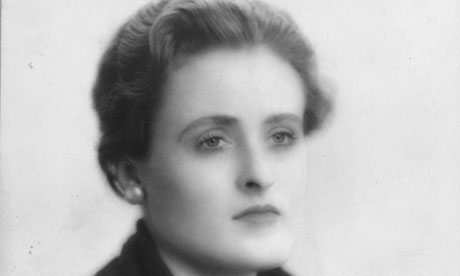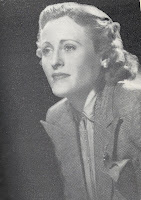
(Left, Nerina Shute in the late 1930s)
This is the second post in my LGBT history month series on bisexual writer Nerina Shute. If you haven’t read yesterday’s post on why I’m doing this, best to read
here first.
Nerina's life and timesNerina Shute was born to an upper middle class family in Northumberland in 1908, the daughter of Cameron and Renie. Her father was in the army, her mother wrote several scandalous novels which were optioned by Hollywood.
While in California (with Nerina), Renie invested all of her money in a married paramour’s gold mine and when Cameron came to visit them, persuaded him to invest his money too. The married man was killed in a car accident and the goldmine was found to be devoid of gold, meaning that the family lost all their money.
Nerina won a short story competition while still in the USA, despite the fact that she had left school at 14. She came back to Britain from California, aged 18, soon moving to London, where she became a typist at the Times Book Club. Attending dance classes, she met playwright and bohemian stalwart Aimee Stuart, who held frequent parties and gatherings in her central London flat. As Nerina wrote later in We Mixed Our Drinks (where she writes of herself in the third person:
“Shute was an odd, rebellious young woman who happened to come of good family but preferred to be thought a ‘bohemian’ than ‘a lady’ or even ‘a gentlewoman’. She was untidy, careless and heavily made up with lipstick and rouge and eye-black ... Behind a half-hearted attempt at flippancy she was deeply in earnest. Behind her sex-talk and her bad manners she was old fashioned, and full of what she herself sometimes called ‘twisted ideals’.”
In 1927, at the tail end of the silent picture era, Nerina was offered a job as a reporter on Film Weekly. She interviewed many celebrities, and did not mince her words, offending many film stars such as
Madeleine Carroll, who she described as a “ruthless Madonna”.
Here she is in The First Born, a great (silent)film that was restored/relaunched recently by the BFI.

Nerina also made a nuisance of herself around film sets: director E A Dupont banned her from his productions, and she once returned disguised as a rabbi to see what was going on.
In 1931, her first, autobiographical novel, Another Man’s Poison was published, causing scandal with her relatives, and attracting reviews, as one of its main characters, Paula, describes herself as ambisextrous. This received a fortuitous review from Rebecca West in The Daily Telegraph:
“Miss Shute writes not so much badly as barbarously, as if she had never read anything but a magazine, never seen any picture but a moving one, heard any music except at restaurants. Yet she is full of talent.” (Shute, 1944:40)
This was excellent publicity for Nerina, despite the fact that she was hurt by it, thinking it an accurate criticism. As “the girl with the barbarous touch” she wrote a series of articles for the Sunday Graphic newspaper at 10 guineas a week (compared to £4 for her job at Film Weekly), giving the opinions of “the ultra-modern girl”. Subsequently, she was invited to Lord Beaverbrook’s estate (he was then owner of the Express newspapers) and given a job as a general reporter at the Express, where she was sacked again, this time after six months.
“Far from being a good reporter, she was inexperienced, useless at writing a straightforward news-story, and on top of these fundamental drawbacks, as everyone probably knew, she disliked her job.”
Nerina was aware of her attractions to women from the 1920s on, and was nervous about them. She did not want to become a lesbian, feeling that the societal opprobrium was too great, and she felt “hurt and diminished” by this prejudice.
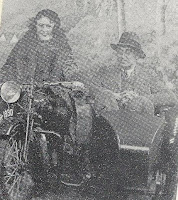
But around this time, she met “Charles”, a doctor who had been struck off for performing an illegal abortion. Feeling lonely, and anxious to lose her virginity, they began a relationship and were soon in love. After some months, she went to “live in sin” in Liverpool with him, where he had got a job as a condensed-milk salesman. She became jealous, however, which caused arguments, and so she left him and returned to London. Here they are, posing on Blackpool Pleasure Beach, in 1930.
Once more, she became a journalist, where she says she was obliged by her editor to write light stories which she felt were wrong in times of terrible poverty. For instance, she was sent to investigate nudist clubs and colonies “which were springing up in the green fields of England like rude little mushrooms”. She went to visit nudists in Earl’s Court but was amused to find that, for the interview, they were clothed. The editor wanted her to write stories about how they were immoral but she liked the nudists she met and wouldn’t do it.
Like very many creative (and other) people of that time, she was attracted by what appeared to be the greater equality in Russia, although after a trip there she also offended Russian Communists she met by saying they had replaced religion with politics.
Around this time, she also began a relationship with a woman she calls “Josephine”, who was a close friend and lover until the end of the 1930s.
Disillusioned with journalism, and by the lack of success of a play she had written, in 1935 she began to work for Max Factor as their publicity manager, doing what she described as “commercial propaganda” and becoming what she called a “Bond Street blonde” – well dressed and groomed, wearing high heels and bleaching her brown hair. This was a dramatic contrast to her previous look of androgynous messiness, complete with black hat. She was also briefly married to James Wentworth-Day, a high Tory journalist, who attracted her with his strongly felt ideals, even as she furiously disagreed with them. The marriage only lasted a year.
He was around 40 when they married, so I imagine this is him in the 50s:

By 1937, Nerina had lost her eagerness to write:
“A few years ago Shute had been the budding novelist and journalist, a young woman of rebellious thoughts who dreamed each night of rising up and up into the golden heights, creating with words the brave people and the lovely places she saw so clearly in her New World. Full of ambition, she had been a pig-headed untidy young romantic; she intended to write what she believed, live as she wanted, and to hell with criticism”.
In 1939, while riding her horse in Rottingdean, Sussex, she met Helen Mayo and Andy Sharpe, two women who lived in Portland Place in London and worked as a dental surgeon and obstetrician respectively. She went to live with them, becoming Helen’s lover, and worked as a nurse, almoner, and ambulance driver, throughout the war.
She also met her second husband,
Howard Marshall, in 1940, a very prominent radio journalist, and the first person to broadcast ball-by-ball cricket commentary.
For the duration of the war, their relationship was intense and idyllically romantic, much of it carried on in intense secrecy as he was both famous and still married, his wife and sons being in America for safety.
This – Begin the Beguine - is one of the songs they used to dance to:
They married in 1944 and were both strongly socialist at this time, endlessly discussing what a better world might look like. Still, however, she had creative ambition: “... she was not a good enough writer. With all her heart she envied the experienced word-wealthy people”. She did, however, publish We Mixed Our Drinks (discussed in the previous post).
In the immediate post-war period, their relationship was “blissfully happy” despite the fact that they were both unemployed and in general found this period difficult:
“When all the excitement was over we all had a feeling of anticlimax. We had done our job. We had won the war. We were unprepared for the long littleness of life.”
What a telling quote! Their intense relationship soon began to show cracks: she wanted to go out, he wanted to stay in. For some years, she acquiesced to this, despite increasing loneliness. When Howard began to work in PR in late 1945, they hired a French housekeeper, "Renee". Renee brought fun and joy into what, over the next few years, became an increasingly unhappy marriage. They loved each other but were wildly incompatible.
Howard did, however, support her quieter, more intellectual endeavours. Nerina studied English at London university, and began to write the first of her historic novels. This one, about Shelley, was published in 1951

After a few years, Nerina and Renee began a sexual relationship (instigated by Renee) which seems to have been maternal on Nerina’s side. Renee, however, was in fact in her 30s, and her mental health was deteriorating. Her family had died in a bombing raid in France, and she had found parts of her mother’s body scattered in the ruins of their home.
Towards the end of her three-year stay with Nerina and Howard, Renee had a serious nervous breakdown, eventually returning to France. Nerina then became very depressed as well and sounds as if she were on the edge of a breakdown herself. “The longing to escape had returned ... this time I felt a desire to die”.
During a furious argument with Howard on New Year’s Eve 1953, several years after Renee had returned to France, she told him she had had sex with Renee. He had known nothing about her attractions to women. Despite speaking on the phone and writing letters, they never saw each other again, although she maintained until the end of her life that she still loved him.
This is Howard, perhaps in the 1940s.

Nerina went to stay in Sussex with her mother and her mother’s much younger and alcoholic sixth husband, Noel. While her depression lifted rapidly, she, her mother and step-father struggled financially, negotiating with the Inland Revenue, trying to make money on renovating houses and moving, or selling off parcels of land. Over the next four years, as her mother’s health deteriorated, Nerina wrote a memoir of Renie’s life Come into the Sunlight, designed to be a reflection of her mother’s joyful philosophy of life. After her death, Nerina and Noel soon moved to London, where they lived in Chelsea, at this time just starting to be the centre of Swinging London.
When she and Noel decided to take ballroom dancing lessons (so Nerina could take Noel’s mind off drinking) they were taught by Phyllis Haylor.
Nerina and Phyllis began a relationship and remained lovers until Phyllis’s death. This was, according to Nerina, a very happy relationship although no particular details emerge in her late-life autobiography Passionate Friendships.
“Phyllis made me happy with an adoration based on a need for motherly tenderness which only a woman can give to another woman. Now, late in life, Phyllis was giving it to me and I was giving it to her. It was like a marriage. We became passionate friends, and our friendship lasted until the day of her death.”
During the 1970s, Nerina wrote two travel and history books about London’s villages, as well as a volume of tell-little autobiography, The Escapist Generations and, in 1986, The Royal Family and the Spencers.

In 1981, Phyllis died suddenly of a heart attack and Nerina was alone once more. Although this is not mentioned by Nerina, her obituaries mention that she began a relationship with another woman, Jocelyn Williams, in 1989, and they stayed together until Nerina died.
In later life, Nerina became as fervent a conservative as she had once been a socialist, but she remained interested in the contemporary world, even as she distanced herself from some of it. With the publication of her final autobiography, Passionate Friendships (1992), she was able to talk more freely about her bisexuality:
“I believe there are many women in the world who need the love of another woman in addition to the love of a man. We are bisexual. Usually we hide this fact from our husbands for fear of ending a happy marriage. I made the mistake of telling my husband ... By explaining how it all happened, and how it ended, I may possibly give help to others.”
So not exactly what bi people tend to think these days, then! Nerina was a product of her class and time, but/and I warm to her and think she would have made a marvellous companion.
In tomorrow’s post, I’ll be writing about some of the questions and issues that studying Nerina’s life has led me to consider.
(The information in this post comes primarily from Nerina’s memoirs and autobiographies, with additional information from Shepperton Babylon, by Matthew Sweet, and from various obituaries.)