Re-reading Octavia Butler & Ursula Le Guin: a lifetime of love and kinship, gender and sexuality in science fiction

Re-reading Octavia Butler & Ursula Le Guin: a lifetime of love and kinship, gender and sexuality in science fiction


octavia1Octavia E. Butler (1947-2006) and Ursula K. Le Guin (1929—) tie as my favourite authors of all time. I read Butler when I was a teenager and discovered Le Guin in my twenties – and now, in middle age, I am reading them again. These writers created amazing stories that gave me, as a growing girl and maturing adult, an array of diverse opportunities to expand my understanding of human beings and how we relate to one another…  and now as a growing-older woman living in a different century than the one the authors and I were born in, I am re-experiencing their works with a whole lot of living behind me and new perspectives. They are still fascinating and challenging, and of course thoroughly entertaining!

Ursula-Le-GuinButler and Le Guin are the bright lights of the literary sub-genre sometimes known as anthropological SF/F (science fiction and fantasy) or, as Le Guin likes to call it, social science fiction. These works explore what it means to be part of the grand notion Humanity, by way of exploring kinship, social organisation, sexual relations, psychology and power. Butler’s and Le Guin’s characters live in societies facing ‘alien’ admixture and challenges to the norm: such as interracial relations; the centralisation of non-heterosexual identities; the juxtaposition of male/female with non-binary gender relationships; the comparison and contrast of monogamy with polygamy, polyandry, polyamory and a variety of other modes of loving and mating; and the radical expansion of the definition of what it means to be a family. All the while providing us with some of the most mesmerising characters in fiction.

In stark contrast with their peers – and quite in sympathy with the imagination of a brown-skinned girl growing up in the 70s & 80s – Butler and Le Guin wrote stories whose characters were not just young, robust, white spacemen with more than a passing resemblance to John Wayne, but people of varying ages and hues (mostly brown and black and grey); people of female, male, asexual, intersex and third-sex biology; and people who formed ‘alternative’ partnerships and families of two, three, four or even five loving mates and (literally, in Butler’s Lilith’s Brood and Seed to Harvest novel series) villages of children and extended relatives.

Their characters were simply people – intensely realised people, both humane and inhumane, from many complexly imagined societies. And they were absolutely fascinating in their ability to evoke a dazzling array of thoughts and emotions, theories of how we are who we are, and challenges about what we human beings have turned out to be vs. what we could evolve into being.


Patternmaster

Which do you prefer… really?

Many have speculated on Butler’s sexuality and claimed her as one of their own, not out of idle curiosity, but because she was so adept at depicting people of any sexual orientation with an even-hand and a sense of given-ness or naturalness that was not the hallmark of her times or even (yet) ours.

This passage, from her first published novel, is a dialogue between the protagonist, Teray, and his new lover and fellow warrior in exile, Amber. They are patternists, humans genetically bred by a near-immortal to have telepathic and healing powers. They travel on horseback through hostile territory on a quest for sanctuary in the land of the Patternmaster. As they speak of their unusually close bond and their pasts, lives and loves, Teray is nervous that Amber may not find him mature enough and wonders whether she would prefer another female lover over him.

Butler’s depiction of Amber’s response brilliantly resonates with the experiences of many bisexual people. Whether Butler herself was bisexual or not, she certainly knew how to pithily and accurately describe one of the central drama’s of a bisexual person’s life when in a relationship with someone struggling to understand them:

~ ~ ~ ~ ~

“Which do you prefer, Amber, really?”

She did not pretend to misunderstand him. “I’ll tell you,” she said softly. “But you won’t like it.”

He looked away from her. “I asked for the truth. Whether I like it or not, I have to know….”

“When I meet a woman who attracts me, I prefer women,” she said. “And when I meet a man who attracts me, I prefer men.”

“You mean you haven’t made up your mind yet.”

“I mean exactly what I said. I told you you wouldn’t like it. Most people who ask want me definitely on one side or the other.”

He thought about that. “No, if that’s the way you are, I don’t mind.”

“Thanks a lot.”

“You know I didn’t mean any offense.”

She sighed. “I know.”

Patternmaster (1976)


TheLeftHandOfDarkness1stEd

Even in a bisexual society the politician is very often something less than an integral man.

Sex is a natural or biological feature and gender is the cultural or learned significance of sex. In The Left Hand of Darkness, Le Guin leads us through a world, Gethen, where the humans are neither male nor female. She asks us to take a look at how our lives are defined by which sex and gender positions we each occupy and the power relations that emerge as a result.

In the novel Le Guin uses the terms ambisexual and bisexual, but not in relation to sexual orientation as we think of it today. Le Guin’s characters, in effect, are biologically without sex. They are bi-sexual or trans-sexual in that, for a brief period each month they take on the sexual characteristics of either a male or a female and then after a few days return to being non-sexed.

Linguistically, Le Guin was faced with a problem: what pronoun would she use for the non-sexed characters? She rejected ‘it’ as too cold and unsuitable for human beings and settled on having her main character -- Genly Ai, a young black man, an envoi from Terra (or Earth) to Gethen  -- use the pronoun ‘he’ as a matter of expedience. This is a decision Le Guin, years after publication, says she regretted, wishing she had created or found a more suitable set of non-gender-specific pronouns to use. This dilemma, I always thought, shows us a great deal about ourselves and our limits in being able to describe, label and negotiate our world.

~ ~ ~ ~ ~

And I saw then again, and for good, what I had always been afraid to see, and had pretended not to see in him: that he was a woman as well as a man. Any need to explain the sources of that fear vanished with the fear; what I was left with was, at last, acceptance of him as he was.

Until then I had rejected him, refused him his own reality... I had not wanted to give my trust, my friendship to a man who was a woman, a woman who was a man…

… it seemed to me, and I think to him, that it was from that sexual tension between us, admitted now and understood, but not assuaged, that the great and sudden assurance of friendship between us rose: a friendship so much needed by us both in our exile, and already so well proved in the days and nights of our bitter journey, that it might as well be called, now as later, love…

But it was from the differences between us, not from the affinities and likenesses, but from the difference, that that love came: and it was itself the bridge, the only bridge, across what divided us.

The Left Hand of Darkness (1969)


Re-reading Octavia Butler & Ursula Le Guin: a lifetime of love and kinship, gender and sexuality in science fiction

Re-reading Octavia Butler & Ursula Le Guin: a lifetime of love and kinship, gender and sexuality in science fiction


octavia1Octavia E. Butler (1947-2006) and Ursula K. Le Guin (1929—) tie as my favourite authors of all time. I read Butler when I was a teenager and discovered Le Guin in my twenties – and now, in middle age, I am reading them again. These writers created amazing stories that gave me, as a growing girl and maturing adult, an array of diverse opportunities to expand my understanding of human beings and how we relate to one another…  and now as a growing-older woman living in a different century than the one the authors and I were born in, I am re-experiencing their works with a whole lot of living behind me and new perspectives. They are still fascinating and challenging, and of course thoroughly entertaining!

Ursula-Le-GuinButler and Le Guin are the bright lights of the literary sub-genre sometimes known as anthropological SF/F (science fiction and fantasy) or, as Le Guin likes to call it, social science fiction. These works explore what it means to be part of the grand notion Humanity, by way of exploring kinship, social organisation, sexual relations, psychology and power. Butler’s and Le Guin’s characters live in societies facing ‘alien’ admixture and challenges to the norm: such as interracial relations; the centralisation of non-heterosexual identities; the juxtaposition of male/female with non-binary gender relationships; the comparison and contrast of monogamy with polygamy, polyandry, polyamory and a variety of other modes of loving and mating; and the radical expansion of the definition of what it means to be a family. All the while providing us with some of the most mesmerising characters in fiction.

In stark contrast with their peers – and quite in sympathy with the imagination of a brown-skinned girl growing up in the 70s & 80s – Butler and Le Guin wrote stories whose characters were not just young, robust, white spacemen with more than a passing resemblance to John Wayne, but people of varying ages and hues (mostly brown and black and grey); people of female, male, asexual, intersex and third-sex biology; and people who formed ‘alternative’ partnerships and families of two, three, four or even five loving mates and (literally, in Butler’s Lilith’s Brood and Seed to Harvest novel series) villages of children and extended relatives.

Their characters were simply people – intensely realised people, both humane and inhumane, from many complexly imagined societies. And they were absolutely fascinating in their ability to evoke a dazzling array of thoughts and emotions, theories of how we are who we are, and challenges about what we human beings have turned out to be vs. what we could evolve into being.


Patternmaster

Which do you prefer… really?

Many have speculated on Butler’s sexuality and claimed her as one of their own, not out of idle curiosity, but because she was so adept at depicting people of any sexual orientation with an even-hand and a sense of given-ness or naturalness that was not the hallmark of her times or even (yet) ours.

This passage, from her first published novel, is a dialogue between the protagonist, Teray, and his new lover and fellow warrior in exile, Amber. They are patternists, humans genetically bred by a near-immortal to have telepathic and healing powers. They travel on horseback through hostile territory on a quest for sanctuary in the land of the Patternmaster. As they speak of their unusually close bond and their pasts, lives and loves, Teray is nervous that Amber may not find him mature enough and wonders whether she would prefer another female lover over him.

Butler’s depiction of Amber’s response brilliantly resonates with the experiences of many bisexual people. Whether Butler herself was bisexual or not, she certainly knew how to pithily and accurately describe one of the central drama’s of a bisexual person’s life when in a relationship with someone struggling to understand them:

~ ~ ~ ~ ~

“Which do you prefer, Amber, really?”

She did not pretend to misunderstand him. “I’ll tell you,” she said softly. “But you won’t like it.”

He looked away from her. “I asked for the truth. Whether I like it or not, I have to know….”

“When I meet a woman who attracts me, I prefer women,” she said. “And when I meet a man who attracts me, I prefer men.”

“You mean you haven’t made up your mind yet.”

“I mean exactly what I said. I told you you wouldn’t like it. Most people who ask want me definitely on one side or the other.”

He thought about that. “No, if that’s the way you are, I don’t mind.”

“Thanks a lot.”

“You know I didn’t mean any offense.”

She sighed. “I know.”

Patternmaster (1976)


TheLeftHandOfDarkness1stEd

Even in a bisexual society the politician is very often something less than an integral man.

Sex is a natural or biological feature and gender is the cultural or learned significance of sex. In The Left Hand of Darkness, Le Guin leads us through a world, Gethen, where the humans are neither male nor female. She asks us to take a look at how our lives are defined by which sex and gender positions we each occupy and the power relations that emerge as a result.

In the novel Le Guin uses the terms ambisexual and bisexual, but not in relation to sexual orientation as we think of it today. Le Guin’s characters, in effect, are biologically without sex. They are bi-sexual or trans-sexual in that, for a brief period each month they take on the sexual characteristics of either a male or a female and then after a few days return to being non-sexed.

Linguistically, Le Guin was faced with a problem: what pronoun would she use for the non-sexed characters? She rejected ‘it’ as too cold and unsuitable for human beings and settled on having her main character -- Genly Ai, a young black man, an envoi from Terra (or Earth) to Gethen  -- use the pronoun ‘he’ as a matter of expedience. This is a decision Le Guin, years after publication, says she regretted, wishing she had created or found a more suitable set of non-gender-specific pronouns to use. This dilemma, I always thought, shows us a great deal about ourselves and our limits in being able to describe, label and negotiate our world.

~ ~ ~ ~ ~

And I saw then again, and for good, what I had always been afraid to see, and had pretended not to see in him: that he was a woman as well as a man. Any need to explain the sources of that fear vanished with the fear; what I was left with was, at last, acceptance of him as he was.

Until then I had rejected him, refused him his own reality... I had not wanted to give my trust, my friendship to a man who was a woman, a woman who was a man…

… it seemed to me, and I think to him, that it was from that sexual tension between us, admitted now and understood, but not assuaged, that the great and sudden assurance of friendship between us rose: a friendship so much needed by us both in our exile, and already so well proved in the days and nights of our bitter journey, that it might as well be called, now as later, love…

But it was from the differences between us, not from the affinities and likenesses, but from the difference, that that love came: and it was itself the bridge, the only bridge, across what divided us.

The Left Hand of Darkness (1969)


‘Bisexevil’ ~ Uganda: hate in focus

‘Bisexevil’ ~ Uganda: hate in focus


r-UGANDA-GAY-PROTEST-large570


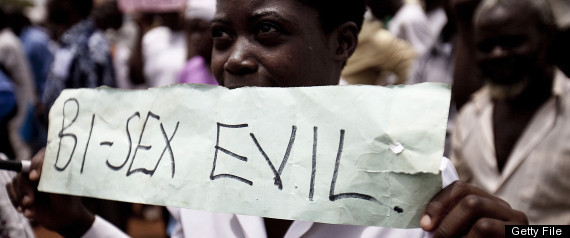
When I saw this now almost-iconic image of Ugandan anti-LGBT sentiment in a news report back in 2010, I didn’t notice at first that the text on the hand-drawn sign forged a pun: bi-sex evil = bisexevil = bisexual.

Bigot humour. How droll.

Actually, what I’d noticed first was the determined period or full-stop at the end of the words, as if what was scrawled on this sign was actually a sentence and what it had to say was the final word on the matter. But then I noticed the teenaged girl’s eyes.

I didn’t see hate in those eyes the first time I saw this photo. I still don’t. The girl seems muddled, seeking direction, not entirely in control of the hateful spirit in the note she holds. The paper partially obscures her face – her mouth, actually – as if she’s not sure of her own words, so she’s letting the sign speak for her. She doesn’t exhibit the wild-eyed rancour or grim-fisted visage I’ve seen in other photographs, though she is rather riveted to what I assume is a person speaking at some spot in the distance. A pulpit, maybe? The people behind her are blurred, but they are in relatively disciplined rows and the crisp, clean shirts in focus add to the feel that this is a ‘Sunday best’ environment. I’m going with that – church. And in reading this image further, I’m going with the narrative that this girl, seeking leadership from the pulpit, either picked up or scribbled this sign in an attempt to curry favour with the crowd around her, the people she came with, and most importantly the ‘leader’ in front of her on whom she fixes her eyes: Look at me. See what I have here. I’m listening to you. I have no mouth of my own, carve me one with your words. I will follow your lead.

Hate is taught. And she is learning.

Fundamentalist religion in Uganda, all across Africa and the world, is leading the battle to attack lesbian, gay, bisexual and transgender people, to deny them human rights, civil rights and even life. Home-grown Ugandan religious-based hatred is being buffeted by imported American evangelical Christians and their ’cures’ for what ails the non-heterosexual, non-gender-normative members of society. They begin by maliciously defining what LGBT people are: gay men are, by their definition, nothing but coprophagiacs and paedophiles; lesbians are mentally ill women pretending to be men and, as with the more highly publicised cases in South Africa, they can be cured by rape, often at the hands of relatives; transgender people are invaded by the spirits of dead people of opposite genders and can become victims of ‘crusades’ that use sexual and physical abuse to cleanse them; and bisexuals are recklessly predatory AIDS-carriers incapable of not forcing sexual relations with anyone in their sight and are thereby ‘evil’ – full-stop.

All LGBT people in Uganda live with the risk of shameless attacks on the street, in their homes, in churches, in sports facilities, anywhere someone chooses to shout out ‘there is one!’ and draw attention to them or, worse, cause an impromptu mob to attack. They risk loss of employment, mental and emotional abuse by strangers and loved ones alike, and often when they suffer from alcoholism, depression, suicidal  thoughts, extreme stress, peer pressure, threats of divorce or relationship break-up, they cannot access appropriate psychological and health care, because that means having to out themselves and their partners to medical personnel.

When LGBT people complain about such treatment and the enormous pressure it places on their lives, the response from religious leaders, politicians, medical professionals, educators, and society at large: repent. Just stop your wicked ways.

Well, gay men cannot and should not be asked ‘to repent’, if that means to never love, never make love, or to forever live hiding in a soul-destroying closet. Lesbians cannot just ‘be discreet’, wear frilly dresses and avoid reading lesbian magazines, so as not to draw attention to themselves. Transgendered people cannot just forget their needs and feelings and happily subsume themselves in the gender assigned to them at birth, occasionally attending ceremonies to clean their spirits. And bisexuals cannot indiscriminately choose any partner of the opposite sex to hide behind just ‘because they can’ and forever deny their ability to love someone whatever their gender and all the personal, social, communal and political realities that come with having that orientation to life.

The prevalent accusation in the west that bisexuals can never be taken seriously in the fight for LGBT rights because they can always hide under ‘heterosexual privilege’, just choosing opposite sex partners (no matter whom they have actually fallen in love with) and eschewing their ‘gay side’ in order to avoid persecution – this is a moot point in Uganda, where the bisexual movement has risen to stand alongside other fellow LGBTI fighters for human rights. Bisexuals are visible and working for change. Ugandan LGBTI individuals do indeed have to hide much of themselves on a day-to-day basis to protect their lives and livelihoods, but as a group and a force, the LGBTI community of Uganda is one of the most visible, brave and determined the world has seen.

And because of the murder of teacher and activist David Kato, the highly publicised deportation case of asylum seeker Brenda Namigadde, and the threat of the death penalty for ‘aggravated homosexuality’ and same-sex relationships in Uganda, the world is beginning to take notice.

They deserve our support, not just in sentiment, but in donations to relevant activist groups, student organisations, churches and charities that help LGBT people, calls and emails to our political representatives, making our supportive voices heard in the media, and determining that no matter what sexual orientation we are that when we hear homophobic, biphobic or transphobic statements about people in Uganda (or anywhere in the world), that we speak up and let it be known that we do not adhere to such ideas and we will not tolerate hate around us. Each of us is just one voice, but our voices add up to change.


I am only one. But still I am one. I cannot do everything,
but still I can do something. I will not refuse
to do the something I can do.
~ Helen Keller
 
alg_david-kato
 
David Kato Kisule, 1964-2011


‘Bisexevil’ ~ Uganda: hate in focus

‘Bisexevil’ ~ Uganda: hate in focus


r-UGANDA-GAY-PROTEST-large570


When I saw this now almost-iconic image of Ugandan anti-LGBT sentiment in a news report back in 2010, I didn’t notice at first that the text on the hand-drawn sign forged a pun: bi-sex evil = bisexevil = bisexual.

Bigot humour. How droll.

Actually, what I’d noticed first was the determined period or full-stop at the end of the words, as if what was scrawled on this sign was actually a sentence and what it had to say was the final word on the matter. But then I noticed the teenaged girl’s eyes.

I didn’t see hate in those eyes the first time I saw this photo. I still don’t. The girl seems muddled, seeking direction, not entirely in control of the hateful spirit in the note she holds. The paper partially obscures her face – her mouth, actually – as if she’s not sure of her own words, so she’s letting the sign speak for her. She doesn’t exhibit the wild-eyed rancour or grim-fisted visage I’ve seen in other photographs, though she is rather riveted to what I assume is a person speaking at some spot in the distance. A pulpit, maybe? The people behind her are blurred, but they are in relatively disciplined rows and the crisp, clean shirts in focus add to the feel that this is a ‘Sunday best’ environment. I’m going with that – church. And in reading this image further, I’m going with the narrative that this girl, seeking leadership from the pulpit, either picked up or scribbled this sign in an attempt to curry favour with the crowd around her, the people she came with, and most importantly the ‘leader’ in front of her on whom she fixes her eyes: Look at me. See what I have here. I’m listening to you. I have no mouth of my own, carve me one with your words. I will follow your lead.

Hate is taught. And she is learning.

Fundamentalist religion in Uganda, all across Africa and the world, is leading the battle to attack lesbian, gay, bisexual and transgender people, to deny them human rights, civil rights and even life. Home-grown Ugandan religious-based hatred is being buffeted by imported American evangelical Christians and their ’cures’ for what ails the non-heterosexual, non-gender-normative members of society. They begin by maliciously defining what LGBT people are: gay men are, by their definition, nothing but coprophagiacs and paedophiles; lesbians are mentally ill women pretending to be men and, as with the more highly publicised cases in South Africa, they can be cured by rape, often at the hands of relatives; transgender people are invaded by the spirits of dead people of opposite genders and can become victims of ‘crusades’ that use sexual and physical abuse to cleanse them; and bisexuals are recklessly predatory AIDS-carriers incapable of not forcing sexual relations with anyone in their sight and are thereby ‘evil’ – full-stop.

All LGBT people in Uganda live with the risk of shameless attacks on the street, in their homes, in churches, in sports facilities, anywhere someone chooses to shout out ‘there is one!’ and draw attention to them or, worse, cause an impromptu mob to attack. They risk loss of employment, mental and emotional abuse by strangers and loved ones alike, and often when they suffer from alcoholism, depression, suicidal  thoughts, extreme stress, peer pressure, threats of divorce or relationship break-up, they cannot access appropriate psychological and health care, because that means having to out themselves and their partners to medical personnel.

When LGBT people complain about such treatment and the enormous pressure it places on their lives, the response from religious leaders, politicians, medical professionals, educators, and society at large: repent. Just stop your wicked ways.

Well, gay men cannot and should not be asked ‘to repent’, if that means to never love, never make love, or to forever live hiding in a soul-destroying closet. Lesbians cannot just ‘be discreet’, wear frilly dresses and avoid reading lesbian magazines, so as not to draw attention to themselves. Transgendered people cannot just forget their needs and feelings and happily subsume themselves in the gender assigned to them at birth, occasionally attending ceremonies to clean their spirits. And bisexuals cannot indiscriminately choose any partner of the opposite sex to hide behind just ‘because they can’ and forever deny their ability to love someone whatever their gender and all the personal, social, communal and political realities that come with having that orientation to life.

The prevalent accusation in the west that bisexuals can never be taken seriously in the fight for LGBT rights because they can always hide under ‘heterosexual privilege’, just choosing opposite sex partners (no matter whom they have actually fallen in love with) and eschewing their ‘gay side’ in order to avoid persecution – this is a moot point in Uganda, where the bisexual movement has risen to stand alongside other fellow LGBTI fighters for human rights. Bisexuals are visible and working for change. Ugandan LGBTI individuals do indeed have to hide much of themselves on a day-to-day basis to protect their lives and livelihoods, but as a group and a force, the LGBTI community of Uganda is one of the most visible, brave and determined the world has seen.

And because of the murder of teacher and activist David Kato, the highly publicised deportation case of asylum seeker Brenda Namigadde, and the threat of the death penalty for ‘aggravated homosexuality’ and same-sex relationships in Uganda, the world is beginning to take notice.

They deserve our support, not just in sentiment, but in donations to relevant activist groups, student organisations, churches and charities that help LGBT people, calls and emails to our political representatives, making our supportive voices heard in the media, and determining that no matter what sexual orientation we are that when we hear homophobic, biphobic or transphobic statements about people in Uganda (or anywhere in the world), that we speak up and let it be known that we do not adhere to such ideas and we will not tolerate hate around us. Each of us is just one voice, but our voices add up to change.


I am only one. But still I am one. I cannot do everything,
but still I can do something. I will not refuse
to do the something I can do.
~ Helen Keller
 
alg_david-kato
 
David Kato Kisule, 1964-2011


Mad, Bad & Dangerous to Know, or: ‘how I came to stop worrying and like the word bisexual’, Part 2

Mad, Bad & Dangerous to Know, or: ‘how I came to stop worrying and like the word bisexual’, Part 2


BiTheWay4CouplesI make people nervous. Most bisexuals do.

By people, I mean many (though of course not all) straights, gays and, yes, even other bisexuals, and those who don’t conform to standard categories of sexual orientation.

By nervous, I mean “people wish we would just go away, or at least keep quiet about it.” People think we cannot be trusted. People think we are liars. People think we are devious. People think we are diseased. People have more negative or ‘cold’ feelings about us than about any other social group other than IV drug users.

Wow. I mean – damn.

It’s all quite baffling to me. Because, when you think about it, being bi isn’t really a hard concept to grasp, is it?

“When I fall in love,” as the song goes, “it will be forever.” It’s just that for me and those like me it could be with a man or a woman, a person of any sex or gender. Quite simple on the face of it. So why does it confound people so much? Why do we make so many people nervous? Part of the answer lies in the myths surrounding the word bisexual and the preconceived notions people have of anyone who would publicly lay claim to the label.

Let me settle a few of those myths right now. This is my version of the nigh-on obligatory myth-busting post that pretty much every blog on bisexuality provides:

  • Existence. Yes – we do.
  • Monogamy. Yes – we can.
  • Fidelity. Yes – we can. And – we do.
  • HIV & AIDS. No – it’s not all our fault.
  • Confusion. No – we’re really not.
  • Indecision. No – that’s not what fluidity means.
  • Greed. Yes, we can have just one piece of cake.
  • Pants. Yes – we’re as capable as anyone else of keeping our various bits in them.
  • Choice. No – we cannot choose to be straight; we cannot choose to be gay; we did not choose our sexual orientation in some thoughtlessly frivolous moment of rapacious abandon. Who does?

All human beings are a mix of a myriad aspects, some we accumulate, some we’re born with. I’m monogamous and faithful by choice, for instance, always have been, but my sexual orientation is not a whim, trendy or temporary, and it’s not antithetical to those choices. But, sadly, even in the 21st century that’s still not self-evident to most people. Bisexuals usually have to make it clear who they really are, in some way, shape or form, when the subjects of our family, friends and relationships come up. It’s very inconvenient  -- and, yes, often painful and embarrassing – to have to pause to break down myths just so we can talk freely about key things in our lives and contribute to conversations about the world. I’m not talking about just taking a moment to clarify our sexual orientation or to explain things related to our personal, social and political identities. It’s not about just saying things like, “Oh, I’m bisexual, by the way, and my partner and I were explaining our take on the American Don’t Ask, Don’t Tell policy to our kids the other day.”

I’m talking about always and also having to tear away at the mad, bad and dangerous stereotypes that stick to bisexual people like barnacles to a hull:

“Oh, I’m bisexual, by the way, and my partner and I…. oh, yes, my partner knows I’m bi, so no it’s not a secret, and yes I have only one partner, and no we don’t swing, so no this’s not an invitation for you to join us for a ménage à trois, and no I’m not telling you because I’m trying to proposition you for a bit on the side, and yes you can still trust me, and no I’ve never lied to you just because you never guessed, and no it’s not a dirty word, and yes you can use that word around children, and no I don’t have to stop calling myself bisexual just because I have a family now…. Anyway, we were explaining DADT to the kids the other day…”

Luckily, most bis don’t have to drop all that baggage all the time all at once! Most of us have learned to forge personal strategies to negotiate our interactions and present ourselves to our listeners in a more pithy manner. I would guess that each bi person develops their own signature style for how to handle it. Of course gays, lesbians and trans people have to do the same. But bisexuals have to tear the biphobic barnacles from the hull of the LGBT community, as well as from the straight. We have two closets to repeatedly come out of, and while challenged with defending ourselves from suspicion, ignorance or hate, we must also defend the very fact of our own unique existence, as individuals and as a community, and to myth-bust, to make it clear who we really are, again both as individuals and as a community.

Bisexual-Stick-FiguresMaking things even more challenging – bisexuals don’t always agree on how to fight this good fight (or if the fight is good or if we should fight it at all). And many people who are capable of attraction to either men or women, of loving people of any gender, refuse to call themselves bisexual. Many people don’t like the word.

I was one of those people for a long time. I didn’t use any word at all. The silence started out as a habit and persisted until it became deafening and began to erase too much of my history and to stifle the person I was growing to be.

Historically, there are a variety of reasons people have eschewed the word: [1] it’s been used to mean hermaphrodite, which is a definition that works in botany but not too well for people; [2] it’s been a synonym for swinger, which is not a reality for most people of any sexual orientation (a few bi people are polyamorous, as are some straight and gay people, but that in itself is not the same thing as swinging); [3] it’s been used to describe behaviour (usually in the sense of ‘bad behaviour’), something that people do rather than something that they are; [4] it’s seen as too restricting, partaking of prescribed sexual binaries and not descriptive of the fluid range of human desire or expression, and [5] like other LGBT people, using it could get the shit kicked out of you. For some people, bisexual is just too political a term and they don’t like politicising their sexuality or relationships. For others it can appear too divisive, supposedly detracting from the cause of overall LGBT unity.

For me, it was an issue of respectability. When I was growing up, I wanted to be a respectable girl (right now, I could give a flying fuck and a half, but that attitude only came with middle age!). Bisexual was not a respectable word in the late 70s and 80s, or even now. I got the message very early on, from books, movies, the media and people around me, that good non-serial-killing grown women just didn’t call themselves that and good teenaged girls didn’t stare longingly at movie star boobies one day and sneak behind the school bleachers to catch a kiss from a boy the next. Good girls had to choose and hopefully their choice would be the ‘right’ one. Being very liberal very early on, as I grew up and got into my own life, I worked to surround myself with people who were even more open-minded and liberal than me… so embracing LGBT rights and allowing people to think I was an ally was my first strategy for dealing with the outside world. Inside, my strategy was silence and avoidance – my own personal Don’t Ask, Don’t Tell.

For a long time, I wouldn’t even tell myself. I mean, I made myself nervous. I absorbed all the myths and misconceptions and believed them enough to shun the word ‘bisexual’ for years and to hide my sexual orientation even from myself. I practiced the ‘No, you weren’t checking out her legs, you were just admiring her shoes’ variety of denial. As I got older, I got more confident admitting that I was attracted to women as well as men, but at the time there was no identifiable bisexual community around me, to help me feel accepted and grow into myself without derision or misunderstanding:

“Although patterns of bisexual behaviour have been documented throughout history and across cultures, bisexual men and women have gained recognition as a distinct sexual minority only recently. Bisexuals began to form social and political groups in the 1970s, but it was not until the late 1980s that an organized bisexual movement began to achieve widespread visibility... By the early 1990s, bisexuals were becoming an established presence in the organized gay movement, as reflected in discussions of bisexuality in the gay and lesbian press and the addition of ‘bisexual’ to the names of many gay and lesbian [LGB] organizations and events.”

Eventually, I grew up and got older (hopefully wiser) and stopped worrying so much. I started to like the word, to embrace it as descriptive of a community of like-minded individuals I had a lot in common with. I started to use it, historically, personally and politically. If people knew, they knew. And, yeah, it got better. Not all the time and in all ways, but being fully who I am and acknowledged for my orientation toward life and love, for my fully-fledged identity, is more important to me now than always making a ‘good’ impression or not making waves. So I blog, I vote, I sing, I sign petitions, I network, I volunteer my time, I raise my children to hopefully be caring, open-minded individuals, and whenever I can I let people in my respectable suburban corner of the universe know my mad, bad and dangerous-to-know self in all my glory and, hopefully, they (won’t kick the shit out of me and) will alter any negative impressions or stereotypes they have about the word ‘bisexual’ or the people who dare lay claim to the label.

And that’s it, really – my small bit.


“You are not alone… Become the strong, secure, happy person you are meant to be”
Mad, Bad & Dangerous to Know, or: ‘how I came to stop worrying and like the word bisexual’, Part 2

Mad, Bad & Dangerous to Know, or: ‘how I came to stop worrying and like the word bisexual’, Part 2


BiTheWay4CouplesI make people nervous. Most bisexuals do.

By people, I mean many (though of course not all) straights, gays and, yes, even other bisexuals, and those who don’t conform to standard categories of sexual orientation.

By nervous, I mean “people wish we would just go away, or at least keep quiet about it.” People think we cannot be trusted. People think we are liars. People think we are devious. People think we are diseased. People have more negative or ‘cold’ feelings about us than about any other social group other than IV drug users.

Wow. I mean – damn.

It’s all quite baffling to me. Because, when you think about it, being bi isn’t really a hard concept to grasp, is it?

“When I fall in love,” as the song goes, “it will be forever.” It’s just that for me and those like me it could be with a man or a woman, a person of any sex or gender. Quite simple on the face of it. So why does it confound people so much? Why do we make so many people nervous? Part of the answer lies in the myths surrounding the word bisexual and the preconceived notions people have of anyone who would publicly lay claim to the label.

Let me settle a few of those myths right now. This is my version of the nigh-on obligatory myth-busting post that pretty much every blog on bisexuality provides:

  • Existence. Yes – we do.
  • Monogamy. Yes – we can.
  • Fidelity. Yes – we can. And – we do.
  • HIV & AIDS. No – it’s not all our fault.
  • Confusion. No – we’re really not.
  • Indecision. No – that’s not what fluidity means.
  • Greed. Yes, we can have just one piece of cake.
  • Pants. Yes – we’re as capable as anyone else of keeping our various bits in them.
  • Choice. No – we cannot choose to be straight; we cannot choose to be gay; we did not choose our sexual orientation in some thoughtlessly frivolous moment of rapacious abandon. Who does?

All human beings are a mix of a myriad aspects, some we accumulate, some we’re born with. I’m monogamous and faithful by choice, for instance, always have been, but my sexual orientation is not a whim, trendy or temporary, and it’s not antithetical to those choices. But, sadly, even in the 21st century that’s still not self-evident to most people. Bisexuals usually have to make it clear who they really are, in some way, shape or form, when the subjects of our family, friends and relationships come up. It’s very inconvenient  -- and, yes, often painful and embarrassing – to have to pause to break down myths just so we can talk freely about key things in our lives and contribute to conversations about the world. I’m not talking about just taking a moment to clarify our sexual orientation or to explain things related to our personal, social and political identities. It’s not about just saying things like, “Oh, I’m bisexual, by the way, and my partner and I were explaining our take on the American Don’t Ask, Don’t Tell policy to our kids the other day.”

I’m talking about always and also having to tear away at the mad, bad and dangerous stereotypes that stick to bisexual people like barnacles to a hull:

“Oh, I’m bisexual, by the way, and my partner and I…. oh, yes, my partner knows I’m bi, so no it’s not a secret, and yes I have only one partner, and no we don’t swing, so no this’s not an invitation for you to join us for a ménage à trois, and no I’m not telling you because I’m trying to proposition you for a bit on the side, and yes you can still trust me, and no I’ve never lied to you just because you never guessed, and no it’s not a dirty word, and yes you can use that word around children, and no I don’t have to stop calling myself bisexual just because I have a family now…. Anyway, we were explaining DADT to the kids the other day…”

Luckily, most bis don’t have to drop all that baggage all the time all at once! Most of us have learned to forge personal strategies to negotiate our interactions and present ourselves to our listeners in a more pithy manner. I would guess that each bi person develops their own signature style for how to handle it. Of course gays, lesbians and trans people have to do the same. But bisexuals have to tear the biphobic barnacles from the hull of the LGBT community, as well as from the straight. We have two closets to repeatedly come out of, and while challenged with defending ourselves from suspicion, ignorance or hate, we must also defend the very fact of our own unique existence, as individuals and as a community, and to myth-bust, to make it clear who we really are, again both as individuals and as a community.

Bisexual-Stick-FiguresMaking things even more challenging – bisexuals don’t always agree on how to fight this good fight (or if the fight is good or if we should fight it at all). And many people who are capable of attraction to either men or women, of loving people of any gender, refuse to call themselves bisexual. Many people don’t like the word.

I was one of those people for a long time. I didn’t use any word at all. The silence started out as a habit and persisted until it became deafening and began to erase too much of my history and to stifle the person I was growing to be.

Historically, there are a variety of reasons people have eschewed the word: [1] it’s been used to mean hermaphrodite, which is a definition that works in botany but not too well for people; [2] it’s been a synonym for swinger, which is not a reality for most people of any sexual orientation (a few bi people are polyamorous, as are some straight and gay people, but that in itself is not the same thing as swinging); [3] it’s been used to describe behaviour (usually in the sense of ‘bad behaviour’), something that people do rather than something that they are; [4] it’s seen as too restricting, partaking of prescribed sexual binaries and not descriptive of the fluid range of human desire or expression, and [5] like other LGBT people, using it could get the shit kicked out of you. For some people, bisexual is just too political a term and they don’t like politicising their sexuality or relationships. For others it can appear too divisive, supposedly detracting from the cause of overall LGBT unity.

For me, it was an issue of respectability. When I was growing up, I wanted to be a respectable girl (right now, I could give a flying fuck and a half, but that attitude only came with middle age!). Bisexual was not a respectable word in the late 70s and 80s, or even now. I got the message very early on, from books, movies, the media and people around me, that good non-serial-killing grown women just didn’t call themselves that and good teenaged girls didn’t stare longingly at movie star boobies one day and sneak behind the school bleachers to catch a kiss from a boy the next. Good girls had to choose and hopefully their choice would be the ‘right’ one. Being very liberal very early on, as I grew up and got into my own life, I worked to surround myself with people who were even more open-minded and liberal than me… so embracing LGBT rights and allowing people to think I was an ally was my first strategy for dealing with the outside world. Inside, my strategy was silence and avoidance – my own personal Don’t Ask, Don’t Tell.

For a long time, I wouldn’t even tell myself. I mean, I made myself nervous. I absorbed all the myths and misconceptions and believed them enough to shun the word ‘bisexual’ for years and to hide my sexual orientation even from myself. I practiced the ‘No, you weren’t checking out her legs, you were just admiring her shoes’ variety of denial. As I got older, I got more confident admitting that I was attracted to women as well as men, but at the time there was no identifiable bisexual community around me, to help me feel accepted and grow into myself without derision or misunderstanding:

“Although patterns of bisexual behaviour have been documented throughout history and across cultures, bisexual men and women have gained recognition as a distinct sexual minority only recently. Bisexuals began to form social and political groups in the 1970s, but it was not until the late 1980s that an organized bisexual movement began to achieve widespread visibility... By the early 1990s, bisexuals were becoming an established presence in the organized gay movement, as reflected in discussions of bisexuality in the gay and lesbian press and the addition of ‘bisexual’ to the names of many gay and lesbian [LGB] organizations and events.”

Eventually, I grew up and got older (hopefully wiser) and stopped worrying so much. I started to like the word, to embrace it as descriptive of a community of like-minded individuals I had a lot in common with. I started to use it, historically, personally and politically. If people knew, they knew. And, yeah, it got better. Not all the time and in all ways, but being fully who I am and acknowledged for my orientation toward life and love, for my fully-fledged identity, is more important to me now than always making a ‘good’ impression or not making waves. So I blog, I vote, I sing, I sign petitions, I network, I volunteer my time, I raise my children to hopefully be caring, open-minded individuals, and whenever I can I let people in my respectable suburban corner of the universe know my mad, bad and dangerous-to-know self in all my glory and, hopefully, they (won’t kick the shit out of me and) will alter any negative impressions or stereotypes they have about the word ‘bisexual’ or the people who dare lay claim to the label.

And that’s it, really – my small bit.


“You are not alone… Become the strong, secure, happy person you are meant to be”