Edited 22nd May Big Bi Fun Day 2014 was a blast! I had been…

Chilling out in the quiet room

The bisexual flag

Wibbly-wobbly bisexual

The front desk

Jacq and the flower sticks
Edited 22nd May
Big Bi Fun Day 2014 was a blast! I had been very unwell for a month, so I didn’t know if I would be able to make it, but I’m glad I did. The event was held in Leicester, UK, at the Quaker Friends Meeting House (although the Quakers had no involvement in the event)
The weather was sunny and incredibly hot; the garden was full of happy bi folks, their friends and families. There were quite a few children present who all enjoyed the garden facilities, although I did spot a few adults making castles in the sand pit, and taking advantage of the swings!
I found I had very little energy when I arrived, but I still had a go learning how to use flower sticks (I can twirl it now!). I also enjoyed the quiet room with the free books and games.
I returned home at 5 o’clock, totally exhausted, but I had a brilliant time. Most of the other attendees went to nearby Victoria Park for some more fun in the sun.
Big Bi Fun Day managed to raise enough money to cover their costs, so they will be back in 2015. Many thanks to Sanji for a wonderful event!
My speech for the Manchester IDAHOBIT vigil today
Manchester Council takes another step in recognising bisexuality
Things are improving.
They've just published the annual Communities Of Interest report, which is a kind of "here is the evidence base" document on diversity concerns for the council and for voluntary and private sector organisations they work with. This has been published for many years now, and each time has a section on LG(B)(T).
This is the first time there's been a bi section. Previously we were a subset of lesbians, which, hmmm.
Full report here. Flick past the first 64 pages and you come to:
9.3 Bisexual community
Recent research carried out by BiPhoria in Manchester has suggested that being visible, being included and being acknowledged are some of the main issues for Manchester’s bisexual community. Bisexual people can often experience discrimination from both the gay and heterosexual communities, and at an LGBT Discussion Day event, hosted by the Council in 2011, BiPhoria found that people wanted bisexuality to be referenced explicitly in literature and wanted services to engage more with the bisexual community. This has been a key action for the group since 2011. Bisexual ‘invisibility’, along with bi-erasure and biphobia are recognised as the most common challenges for bisexual people.
Biphobia may be characterised as taking four key forms:––Similar to homophobia
––Similar to heterophobia
––Structural or institutional biphobia
––Internalised biphobia absorbed from a culture of the first three.
Manchester has one of the highest profile bisexual communities in the UK and is home to BiPhoria, and the bisexual magazine Bi Community News. As with any other group that experiences oppression, bisexual people may also encounter additional prejudice due to intersectional marginalised identities, for example bi women, black bisexuals, or bisexual genderqueer people.
Stonewall’s 2009 report ‘Bisexual People In The Workplace’ reflected that the positive impact of LGBT Staff Networks on lesbian and gay employees does not extend to bisexual staff. Research published by the EU Fundamental Rights Agency in 2013 showed that bisexual staff are significantly less likely to feel they can be ‘out’ in the workplace than lesbians or gay men:
The Bisexuality Report (Open University, 2012) reflected that these challenges for many bisexual people also extend into areas such as crime and policing, where homophobic hate crime monitoring may fail to address and recognise bisexuals’ experience of biphobia and homophobia.
It's fun to see my "four flavours of biphobia" model, albeit in very condensed form, in a council document. It's also a bit scary to think that I wrote it about twenty years ago, citing certain Manchester City Council services as examples of institutional and structural biphobia.
Though it is frustrating that there are no specific actions for the council and its partner organisations to take up, I hope this sets a good marker down illustrating some of the key issues for bis and the evidence base underpinning those on which to build in future years.
See It. Hear It. Report It. FA films help rid football of discrimination.
Stonewall: a new dawn for the UK’s top LGBT equality campaign
The joy of bi groups
That’s not to say that nothing has changed though. Where once people came to a group like BiPhoria knowing little more than the words from a poster in a bookshop or a photocopied leaflet they picked up on an outreach stall, work like the Getting Bi In A Gay / Straight World booklet and video means a lot of new members arrive now knowing a lot more, perhaps needing a slightly different kind of a space than we had in the 1990s. That’s good, the world has changed in so many ways and the recipe for a good bi group will change with it.
BiPhoria might still be happening from sheer force of habit, but out there in the rest of the country the desire for bi space and bi meetups has its ebb and flow but is still strong. Last year new groups launched in Edinburgh and London, the latter one focused on bisexuals over 50. And this winter I know of two more about to spring into life in Nottingham and Southampton. Though the latter two are run by people I know, neither will be quite the same shape as BiPhoria. And good luck to ’em: while there are a few ways of running a bi group that I think are wrong, there are surely a lot of ways of doing it right. The more of us who are trying the better our chances of hitting on some really good formulae.
Our LGBT History and the People’s History Museum
In March 2013, when planning the People's History Museum's summer events programme, it seems the suggestion came forward to run an LGBT history tour, to coincide with Manchester Pride at the August bank holiday weekend. The people's history of Manchester, after all, includes a whole series of stories of our place as a key city in the country's LGBT history.
But as a social history it is fleeting and ephemeral, with some of the tales of bars and battles captured by the rainbow plaques on our city streets and many more missing, let alone how they piece into the jigsaw of the battle for liberation and equality on a wider level. If you didn't live through it all back then, then in a 2013 where one of the six parliamentary divisions on same-sex marriage didn't even go to a vote because well it's obviously going to pass why bother, it's hard to imagine how things were for queers of all stripes twenty or forty years ago. It's something that didn't hit home to me until I had the good fortune to meet and spend time with Bernard Greaves, a magnificent gay (and later LGBT) rights activist who has been fighting the proverbial good fight longer than I've been alive.
As Catherine O'Donnell, one of the exhibition organisers, blogged at the time: "(As a straight woman) I knew that there had been a struggle, however I didn’t realise the lengths that campaigners had gone through to gain rights for something as simple and natural as kissing in public, let alone the repeal of Section 28 and equal marriage."
![]() |
| Most of the 'popup' LGBT history exhibition |
Catherine got the plans for an exhibition included in one of LGF's regular circulars and that's where I picked up on it, as it landed the day after I'd had a conversation about archives and the many bi banners BiPhoria has made over the years. Regular readers will know that I work a mixed week, and Wednesday is normally my day of beavering away at various bi volunteering projects at BCN Towers. By sheer chance the two LGBT history workshop afternoon PHM had planned were on Wednesdays, so I could take part without having to take leave from my paid working week. If People's History Museum had picked Fridays for this project it would probably have passed me by.
When you only have two afternoons to bring a group of a dozen or so people together, get them to go through museum archives and their own materials from home, understand broadly how to select, label and present the most important things and turn it into a ready to roll exhibition that's a tough call. While perhaps half of the volunteers contributing history and time to assembling the exhibition already knew one another from a group at LGF that the People's History Museum had done a targeted outreach evening with, the rest of us didn't know one another and there is quite a bit of needing to find a comfort level around strangers and learning to share stories and space. It worked well, though I was always worried I was hogging the floor with stories from twenty years of bi, trans and LGBT activism - or geekily correcting historical references. No, he was bisexual... of course at the time both of them were in the closet... the word dates back to the late 1800s... that's the wrong pronoun... I'll shush now.
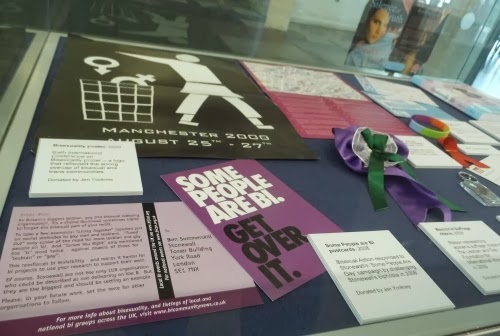
Those exchanges of stories highlighted some of the limitations of the rapid recruit - prepare - present cycle. We had, from what I could tell, a skew toward cis lesbians and gay men among the volunteers. That's not to bemoan any of them being there, just that as so often, ideally there would have been more and different voices. Thanks to my background and extensive if ill-filed bi archives I can hold up the B end well, but I think there was only me and one ally speaking up on trans issues and representation. There was at least some B and T in there though, which was one of the things that made me glad I'd taken part. Especially seeing this little "bisexual corner" with two of my final three nominated items for the display, one of which reflecting the internal struggles within the LGBT umbrella:
![]() |
| "Dear Stonewall, you say you're LGB but you keep letting bisexuals down..." |
It all came together and while it felt a little bit compact-and-bijou compared to a full museum exhibition areas, it was a grand feeling once the frenzy of Pride weekend was over to come in to the museum in September and see it in its polished final form. I got all self-referential and took photos of the projection wall where my own photos were among the rotating display running (many thanks to the kindly front desk people who noticed what I was up to and dimmed the main lights so I could get better snaps!).
![]() |
| That's a photo of a projection of a photo I took of one of my teeshirts. This blogpost may eat itself :) |
Much kudos and congratulation to Harriet Richardson and Catherine O'Donnell from the museum's Play Your Part project, who steered the whole thing through to completion. It was great to see the finished exhibit there at the front of the museum to welcome all visitors, to be a part of make it happen. Further it filled me with thoughts of how to go about exhibiting bisexual community history in particular; but that's a story for another blogpost!
So much more than marriage: #bi 2013
For England and Wales the first six months of the year were the story of the Same-Sex Marriage Bill. Unveiled in February after Westminster’s largest public consultation exercise ever, this seemed to go on forever at the time, and eventually passed by a huge majority in the summer. So great was its success, by later stages the anti-equality camp in the House of Lords – which over the last fifteen years has blocked or delayed so much legislation on bisexual and gay equalities – didn’t even press the decision to a vote. A number of issues remain with the Bill, or Act as it now is, including pensions issues and problems for intersex and genderqueer people, but it was a huge step forward – in a year where many other nations were taking the same step.
February is LGBT History Month and there were no bi-specific events this time around, but twitter saw the launch on January 31st of @bisexualhistory, giving a daily “on this day…” snippet of bi history. It’s now on Facebook too.In May the European Union Fundamental Rights Agency published the findings of a large-scale research project across the EU, looking at how LGBT experiences compare from country to country. Over 93,000 people took part so the scale of the research was much larger than most similar projects. Across the 28 member states, about four in every 10 respondents did not reveal their LGBT identity to anyone in their social environment bar a few friends. However, this rose to half of respondents among bisexual women and transgender people, and three quarters of respondents among bisexual men.
As the summer approached, Shrewsbury MP Daniel Kawczynski came out as bisexual – the first Conservative MP to do so and one of only two out bi MPs currently in Westminster. Sharp as ever the Daily Mail trumpeted Kawczynski as the “first bisexual MP”, forgetting Lib Dem deputy leader Simon Hughes, as well as former MPs like onetime Secretary of State for Wales Ron Davies or Winchester byelection winner Mark Oaten. All three main parties have now had at least one out bi MP, and they have all had openly gay MPs too, which is surely a good thing for keeping legal equalities that have been won over recent years.

It was a year for community-building as new bi social and support groups launched in Edinburgh, in Dublin, and for Bi Professionals and over 50s in London. Annual bi conference / festival BiCon returned to Scotland for the first time since 2006 and saw extensive engagement from LGBT and wider community groups.
Bi Visibility Day on September 23rd was bigger than ever. We saw bi flags flying from buildings around the country including universities, police stations and town halls, a plethora of local events, and support for Bi Visibility Day from both the Department of Culture, Media and Sport and Equalities Minister Jo Swinson, the first time it's had recognition at that level in the UK.
There were new battles to be fought online. In August, Apple backed down on their bi ban – but Google kept theirs in place. Later in the year internet censoring “child protection” filters set up by UK ISPs under pressure from 10 Downing Street turned out to block lots of LGBT info sites like Bi Community News, Bi.Org and more, even including services specifically targeted at vulnerable young people in need of help like Childline.As the year came to a close Scotland picked up the same-sex marriage baton and the Holyrood Parliament had its first debate on the issue. This passed overwhelmingly with further legislative stages to come in 2014.
And then to round the year off we had Olympic medallist Tom Daley‘s non-specific coming out on YouTube, where he talked about having a male partner but didn’t use words like “bisexual” or “gay”, prompted lots of debate online about identity, relationships, labels and bisexual erasure.
So 2013 comes to a close and that naturally takes me to the New Year ahead… some things I'm looking forward to already in the bi calendar:- Two new bi groups launch early in 2014 – watch this space for details!
- The return in July of BiReCon, the bisexuality research and theory conference, along with BiCon in Leeds at the start of August.
- Big Bi Fun Day on May 17th and the BDSM Bisexuals weekend on March 22nd.
As you might have gathered I originally wrote this for BiMedia.