British Queer History book

British Queer History book

Anyone read "British Queer History: New Approaches and Perspectives" by Brian Lewis?http://www.manchesteruniversitypress.co.uk/cgi-bin/indexer?product=9780719088940There being nothing for bisexuality in the index didn't fill me with hope. comments
British Queer History book

British Queer History book

Anyone read "British Queer History: New Approaches and Perspectives" by Brian Lewis?http://www.manchesteruniversitypress.co.uk/cgi-bin/indexer?product=9780719088940There being nothing for bisexuality in the index didn't fill me with hope. comments
For the complete strip, see…

For the complete strip, see…


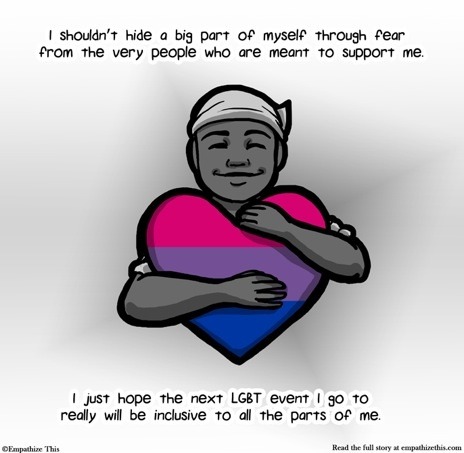
For the complete strip, see http://empathizethis.com/stories/prejudice-pride/


I was interviewed by Empathize This ( http://empathizethis.com) a great website that creates comic strips based on social justice. I contacted them with an idea, and they encouraged me to tell of my experiences attending LGBT pride. They are very open to people sharing their stories, and were helpful through the whole process.

I wish biphobia at LGBT events didn’t happen, but they do at almost every single one I’ve been to. I felt so sad when I saw the image of myself crying at Brighton pride, after I was spat on; it’s one of the most horrible things to happen in a supposedly LGBT space. I remember how alone I felt when it happened. I also remember how that incident still makes me nervous at times. However, the final image of me hugging a bisexual heart makes me smile. I am happy to be bi. I’m happy that I can love others. I just wish lesbian and gay folks would be happy to leave me alone too.

Class and bisexuality

Class and bisexuality

Whenever we look at protected strands, for example code of conduct, BiCon guidelines and feminism or anti-racism discussions we seem to mention class. Most recently I've often seen words like intersectionality and privilege. I’m liking the feeling of trust I have with so many people that we are trying to be expressive and supportive and practical.

Intersectionality absolutely makes sense to me. We are part of many overlapping groups and all have a place in the unequal power landscape in each of the protected characteristics. Part of my learning is spotting my own place and that I’m in there and can label that and not just be the “normal” and others are “ethnic “ or old people or some labelled group. It makes sense that each of our personal environments are combinations and some things come to the fore in some places. I’m used to this happening being the “cyclist” or the “vegetarian” and the “bisexual”

I am a bit wary of this stuff. Partially I’m dealing with my own discomfort around being in the power-over position and acting following my prejudices and biases and harming other people. I need to go deal with that and certainly not expect people I am channeled to punch down towards to use their energy supporting me.

I’m aware of previous anti-oppression arguments and more importantly styles and (mis)representations. I’m aware of stereotyping and ridiculing of say radical feminists and how those conversations, newspapers and cartoons probably shape what I think of as history. I find myself avoiding aligning myself with a ridiculed group and thus are separated from them and we are divided. Humour can also sharply make great points, particularly about ourselves.

I then don’t want to expose my ignorance. I also have the unearned privilege of being able to choose not to spend my time correcting my historical understanding. Right now I’m choosing to focus on the present and future. I am OK being challenged on that choice.

I hope this will be a space to open up a little about my ignorance because it will help me work out how to change it and perhaps give a view into the process of change that others can analyse. I hope that people make an informed choice whether to read this and I do not take up space from the less privileged to muse over my privileged position.

So, in my ignorance I spot the term “multiple oppression” and it sounds a bit dated. Again, “dated” is a dismissal in my aim towards being modern. I know this isn't a thought out position and that is a problem. That noted, I’ll still say it rather than ignore it because it is a bit embarrassing and so perpetuate it. I also note the term “oppression bingo” and give it no more space than that.

I think that modelling lots of axes of oppression can be done to try to understand and change it (kyriarchy, My Gender Workbook spring to mind) and can also be good to get away from compartmentalising everything and losing cross domain learning and solidarity and ignoring intersections and so losing people in the gaps who are most hurt by this stuff.
I also wonder with any model to what extent it models reality, what it is for: what aspects of the world are we highlighting and comparing and putting together or differentiating and why. Is this pyramid supposed to correctly model everybody’s experience? If not, whose does it model and who is not included? Where’s the evidence of fit to the world? Does it fit for me and those I interact with? Also, is my mathematical and sciency tendency towards graphy models the best way to look at this stuff. It certainly isn't the only way and human social interactions can be described in prose and poetry and meditated over without words and form the powerful stuff of art and music and drama and fiction. The science white coat isn't the only thing to wear and I’m aware it is more embraced or more rejected by some as true.

I’m aware some people are more affected by some prejudices than others. Some seem to cause more harm at times than others and to different people. People have differing levels of knowledge and focus. I don’t want to pull energy from other fights for my struggles of personal interest. I am aware everyone has limited resources. I’m also aware my resources come partially from a history of oppression and unearned privilege and may be gained and used every day in ways that harm others.

I’ll admit right here that the word “privilege” passes my eyes and ears many days and doesn't engage with my brain. Partially that happens to any commonly used word: under/over definition as general semantics would say (a big part of how I interpret the world)

I reject single radix politics: that every problem comes down to one fundamental thing.

I read of that single root idea mainly from Marxism – that oppressions come from a more basic class struggle and capitalism is named. I find a certain brand of communist activist, while aligned with my thinking in some ways and when our aims intersect, really boring. I’m also highly critical of the idea that things not being right should be allowed or encouraged to build up to a sufficient head of steam to power a revolution. I and my world are not your cannon fodder. That said, I don’t think the economic and class status quo is OK, particularly for queers. Neither do I have a clear idea of how to fix that.

I’d like to know more about anarchist and feminist and Quaker and non-violence and other methods of building change so the ends and the means both do good and not harm.

So: the thing I was trying to get to when I started this: CLASS.

I hear class highlighted when we look through the lens of official protected characteristics and it isn't there. I hear it rejected with gusto both by people who reject socialism and people who want to keep an apolitical position and not take up term that favour the left.

I read older bi texts and there is an affinity with certain political parties. Then I read of accessibility and wanting a broad community and welcoming all. Then I read of important differences and oppressions being glossed over for the sake of unity or drama avoidance or the unacceptable being thrown under a bus for the rights of the already slightly more powerful. Then I read of history of homophobia from all parties and support from all and the struggle to rewrite and selectively highlight history to favour a favourite political position. Then I hear politics and think of pointless student posturing and then I think of politicians: Then I get angry and distracted or turned off an bored and I don’t want to so…

Back to CLASS.

I hear it strongly attached to race in US and international context.

I hear it from working class folks and people who work with them.

I know some of the places I've been and places I go are very class based. I probably get manipulated all of the time by advertisers trying to play on my class desires and fears.
I ask every now and then about reading on class and get few suggestions outside of Engels or blogs which are interesting but very US context based and also are blogs, not a collected and structured resource or marshalled teaching or argument like a good book. I also wonder if I’m making excuses not to engage.

I’m aware my own class background is a bit weird. I’m generally wary, and with good reason, of being labelled by others and so I’m also wary of asking others to tell me what class I am and what that means.

I've read Watching the English.

I want to read more and understand this more and talk about this more and understand my position in the landscape of class and what that means I do and have done to me and what I might want to change about all that.

What do I do now?

comment count unavailable comments
Class and bisexuality

Class and bisexuality

Whenever we look at protected strands, for example code of conduct, BiCon guidelines and feminism or anti-racism discussions we seem to mention class. Most recently I've often seen words like intersectionality and privilege. I’m liking the feeling of trust I have with so many people that we are trying to be expressive and supportive and practical.

Intersectionality absolutely makes sense to me. We are part of many overlapping groups and all have a place in the unequal power landscape in each of the protected characteristics. Part of my learning is spotting my own place and that I’m in there and can label that and not just be the “normal” and others are “ethnic “ or old people or some labelled group. It makes sense that each of our personal environments are combinations and some things come to the fore in some places. I’m used to this happening being the “cyclist” or the “vegetarian” and the “bisexual”

I am a bit wary of this stuff. Partially I’m dealing with my own discomfort around being in the power-over position and acting following my prejudices and biases and harming other people. I need to go deal with that and certainly not expect people I am channeled to punch down towards to use their energy supporting me.

I’m aware of previous anti-oppression arguments and more importantly styles and (mis)representations. I’m aware of stereotyping and ridiculing of say radical feminists and how those conversations, newspapers and cartoons probably shape what I think of as history. I find myself avoiding aligning myself with a ridiculed group and thus are separated from them and we are divided. Humour can also sharply make great points, particularly about ourselves.

I then don’t want to expose my ignorance. I also have the unearned privilege of being able to choose not to spend my time correcting my historical understanding. Right now I’m choosing to focus on the present and future. I am OK being challenged on that choice.

I hope this will be a space to open up a little about my ignorance because it will help me work out how to change it and perhaps give a view into the process of change that others can analyse. I hope that people make an informed choice whether to read this and I do not take up space from the less privileged to muse over my privileged position.

So, in my ignorance I spot the term “multiple oppression” and it sounds a bit dated. Again, “dated” is a dismissal in my aim towards being modern. I know this isn't a thought out position and that is a problem. That noted, I’ll still say it rather than ignore it because it is a bit embarrassing and so perpetuate it. I also note the term “oppression bingo” and give it no more space than that.

I think that modelling lots of axes of oppression can be done to try to understand and change it (kyriarchy, My Gender Workbook spring to mind) and can also be good to get away from compartmentalising everything and losing cross domain learning and solidarity and ignoring intersections and so losing people in the gaps who are most hurt by this stuff.
I also wonder with any model to what extent it models reality, what it is for: what aspects of the world are we highlighting and comparing and putting together or differentiating and why. Is this pyramid supposed to correctly model everybody’s experience? If not, whose does it model and who is not included? Where’s the evidence of fit to the world? Does it fit for me and those I interact with? Also, is my mathematical and sciency tendency towards graphy models the best way to look at this stuff. It certainly isn't the only way and human social interactions can be described in prose and poetry and meditated over without words and form the powerful stuff of art and music and drama and fiction. The science white coat isn't the only thing to wear and I’m aware it is more embraced or more rejected by some as true.

I’m aware some people are more affected by some prejudices than others. Some seem to cause more harm at times than others and to different people. People have differing levels of knowledge and focus. I don’t want to pull energy from other fights for my struggles of personal interest. I am aware everyone has limited resources. I’m also aware my resources come partially from a history of oppression and unearned privilege and may be gained and used every day in ways that harm others.

I’ll admit right here that the word “privilege” passes my eyes and ears many days and doesn't engage with my brain. Partially that happens to any commonly used word: under/over definition as general semantics would say (a big part of how I interpret the world)

I reject single radix politics: that every problem comes down to one fundamental thing.

I read of that single root idea mainly from Marxism – that oppressions come from a more basic class struggle and capitalism is named. I find a certain brand of communist activist, while aligned with my thinking in some ways and when our aims intersect, really boring. I’m also highly critical of the idea that things not being right should be allowed or encouraged to build up to a sufficient head of steam to power a revolution. I and my world are not your cannon fodder. That said, I don’t think the economic and class status quo is OK, particularly for queers. Neither do I have a clear idea of how to fix that.

I’d like to know more about anarchist and feminist and Quaker and non-violence and other methods of building change so the ends and the means both do good and not harm.

So: the thing I was trying to get to when I started this: CLASS.

I hear class highlighted when we look through the lens of official protected characteristics and it isn't there. I hear it rejected with gusto both by people who reject socialism and people who want to keep an apolitical position and not take up term that favour the left.

I read older bi texts and there is an affinity with certain political parties. Then I read of accessibility and wanting a broad community and welcoming all. Then I read of important differences and oppressions being glossed over for the sake of unity or drama avoidance or the unacceptable being thrown under a bus for the rights of the already slightly more powerful. Then I read of history of homophobia from all parties and support from all and the struggle to rewrite and selectively highlight history to favour a favourite political position. Then I hear politics and think of pointless student posturing and then I think of politicians: Then I get angry and distracted or turned off an bored and I don’t want to so…

Back to CLASS.

I hear it strongly attached to race in US and international context.

I hear it from working class folks and people who work with them.

I know some of the places I've been and places I go are very class based. I probably get manipulated all of the time by advertisers trying to play on my class desires and fears.
I ask every now and then about reading on class and get few suggestions outside of Engels or blogs which are interesting but very US context based and also are blogs, not a collected and structured resource or marshalled teaching or argument like a good book. I also wonder if I’m making excuses not to engage.

I’m aware my own class background is a bit weird. I’m generally wary, and with good reason, of being labelled by others and so I’m also wary of asking others to tell me what class I am and what that means.

I've read Watching the English.

I want to read more and understand this more and talk about this more and understand my position in the landscape of class and what that means I do and have done to me and what I might want to change about all that.

What do I do now?

comment count unavailable comments
Edited 22nd May

Big Bi Fun Day 2014 was a blast!  I had been…

Edited 22nd May Big Bi Fun Day 2014 was a blast! I had been…


Chilling out in the quiet room


The bisexual flag


Wibbly-wobbly bisexual


The front desk


Jacq and the flower sticks

Edited 22nd May

Big Bi Fun Day 2014 was a blast! I had been very unwell for a month, so I didn’t know if I would be able to make it, but I’m glad I did. The event was held in Leicester, UK, at the Quaker Friends Meeting House (although the Quakers had no involvement in the event)

The weather was sunny and incredibly hot; the garden was full of happy bi folks, their friends and families. There were quite a few children present who all enjoyed the garden facilities, although I did spot a few adults making castles in the sand pit, and taking advantage of the swings!

I found I had very little energy when I arrived, but I still had a go learning how to use flower sticks (I can twirl it now!). I also enjoyed the quiet room with the free books and games.

I returned home at 5 o’clock, totally exhausted, but I had a brilliant time. Most of the other attendees went to nearby Victoria Park for some more fun in the sun.

Big Bi Fun Day managed to raise enough money to cover their costs, so they will be back in 2015. Many thanks to Sanji for a wonderful event!