The good, the bad and the ugly (of teaching)
28… years on
One of the joys of life today is that when you talk to young people, even politically informed queer young people, you have to explain what it was. Often this is followed by some incredulity that people thought such a thing was OK, let alone a popular vote-winner, just a few years ago. Yet David Cameron got elected into parliament through a campaign that included attacking the politically correct rascals on the other side with their wicked intentions to repeal the law.
Section 28 as it would be known, Section 2A as it more strictly became once law, and "the clause" in popular parlance at the time it was going through parliament, was an amendment to the 1986 Local Government Act, which said:
Prohibition on promoting homosexuality by teaching or by publishing material.
(1)The following section shall be inserted after section 2 of the Local Government Act 1986 (prohibition of political publicity)—
2A“ Prohibition on promoting homosexuality by teaching or by publishing material.In practice and in intent, Section 28 made homosexuality a thought crime, an act which Russia is busy proving to us was not solely possible off the back of 1980s HIV hysteria, though back in the 80s that probably helped. Despite the "homo" wording it was a bi and trans issue too, as there was such a deep lack of grasp of LGBT in the public consciousness back then.
(1)A local authority shall not—
(a)intentionally promote homosexuality or publish material with the intention of promoting homosexuality;
(b)promote the teaching in any maintained school of the acceptability of homosexuality as a pretended family relationship.
(2)Nothing in subsection (1) above shall be taken to prohibit the doing of anything for the purpose of treating or preventing the spread of disease.
(3)In any proceedings in connection with the application of this section a court shall draw such inferences as to the intention of the local authority as may reasonably be drawn from the evidence before it.
(4)In subsection (1)(b) above “maintained school” means,—
(a)in England and Wales, a county school, voluntary school, nursery school or special school, within the meaning of the Education Act 1944; and
(b)in Scotland, a public school, nursery school or special school, within the meaning of the Education (Scotland) Act 1980.”
(2)This section shall come into force at the end of the period of two months beginning with the day on which this Act is passed.
It was a vague law - I remember hearing one Tory MP defend it to an LGBT audience claiming that as it was so poorly worded it didn't mean anything and therefore couldn't be homophobic in effect and did no harm. Fair play, if you're going to lie, make it a big one.
Actually the looseness of the language meant that it could be argued to prevent anything homophobes in positions of power wanted to stop happening. I saw it used to block information for schoolkids who wanted to know their human rights, to bar newspapers appearing in libraries, and to silence those who wanted to support people struggling with their gender or sexuality. Even where there was support for gay people, it was used as an excuse to defend biphobia (to paraphrase but not by much, "section 28 means we can't give help or recognition to bi people, as that would encourage straight people to become gay")
It was a populist backbench Conservative bill introduced with Labour support, leaving only the Lib Dems on the other side of the argument. The Lib Dems had slightly more MPs than they do now but were still helplessly outnumbered. Knowing it was unlikely to be stopped outright, Bermondsey MP Simon Hughes brought forward changes that would have watered the measure down, but they lacked support beyond his own party. Labour's grassroots members started pressing their party's MPs to change tack and oppose the measure, but that took some time: and even if they could be persuaded, Margaret Thatcher was sitting on a majority of 100.
And so on May 24th, 1988 it became law. It was the post-1967 nadir of LGBT equalities in the UK, adding to a litany of inequalities: employment, age of consent, adoption, partnership recognition, pensions, housing and so on.
But it had a galvanising effect on the LGBT community, not least by giving lesbians and gay men a common cause to fight around. Like the baddy in any story, the politically active queer organisations and individuals it spawned would bring about its own downfall, and spur momentum toward the near-equality we have for LGBT people with straight cisgender people today.
It should have been gone in 1997 when the Tories left power, as the new government had pledged to a tight spending programme but here was something positive for society that could be done at no cost. Alas Labour chose not to include repeal of Section 28 in their manifesto. In the great tension of "what is right to do" versus "what will upset the Sun and the Daily Mail", they decided that keeping the tabloids on side was more important than childrens' lives. That meant repeal had to wait until the 2001-2005 parliament as the pro-prejudice majority in the Lords blocked repeal. As it wasn't in the manifesto, Labour felt they couldn't overrule the Lords on the subject.
It went in Scotland in 2000 though - one of the prices of coalition the Lib Dems extracted from Labour at Holyrood; in England and Wales it would stick around until 2003.
I was a teenager in 1988, and though I had newspaper cuttings about the clause on my bedroom wall I no longer remember the day the clause became law. I remember the day it went though; for a little while I thought: we have won, it is ended, I can stop fighting now. Then the next day dawned and there was still far too much wrong in the world to rest just yet.
LGBT Asia: Thoughts About Bisexuality
One of the most honest things I've heard in a while was around jealousy, and how gay men and lesbians may be jealous of bisexuals given we are capable of having heterosexual relationships. As perceived by them, this allows us to gain access to heterosexual privileges and shields us from homophobic discrimination. And yet, our realities are often a little more complicated. It's true that heterosexual relationships are still more socially accepted - whether in Bangladesh or the UK. And in Bangladesh, some very significant legal barriers fall away as soon as you are involved with the opposite sex. And so to a certain extent, I can understand the jealousy. It's rooted in how our world is currently structured and not something to be dismissed - although it's important to note it's not this way because of something bisexuals have done. But there is more to it than that. If you're openly bisexual, the homophobia, and indeed the biphobia, don't suddenly go away. We merely face a different set of prejudices and stereotypes when we enter an opposite-sex relationship - the questions about when we're going to cheat, when we're going to “switch” sexualities again, and of course the "everlasting taint" of any same-sex partners from our past. So yes, while we may be able to get married, and get that couple's honeymoon deal no-awkward-questions-asked, acceptance itself can remain an elusive goal.
This brings me to another point often made about how the word bisexual is a label people use to hide behind and lessen stigma. I can understand somewhat, given what I've just written, how coming out as bisexual may sometimes seem easier. At the event, I was told that this was the reason certain gay men in the Asian community come out as bisexual, thereby creating a sense of mistrust around anyone using the term. People wonder if a man claiming to be bisexual is actually gay and I know the story of the bi-now, gay-later men is an oft repeated one. How these men navigate between these identities can vary, and I've been told by several that the label of bisexuality was in fact a safe halfway house for them. But for others, their sexualities have been fluid, and the change in labels was more an honest necessity. And beyond this are those who are in fact still bisexual, but the biphobia and lack of understanding makes it easier for them live out their lives as gay men. There's a myriad of possibilities here, and it's important to take each story and consider its merits without generalising. The truth is no one really knows what's going on in someone else'd mind, and so no one really know what someone else's sexuality is. Passing judgement is risky business, and often judgement passed is through a prejudiced lens. Effeminate men seem to be one of the biggest targets here – apparently some guys are such queens that there is no way they could be bisexual. However, the reality is someone's mannerisms do not define who they are attracted to or aroused by. If we stripped away the heteronormative assumption that traditionally defined masculine men are the only ones capable of being attracted to women, this would be easier for a lot of us to see.
Going back to the original point about stigma, I also question if telling people you are bisexual really does protect someone from prejudice within South Asian communities, diaspora or otherwise. Based on the personal experiences of myself and others, I cannot imagine how identifying as bisexual instead of homosexual would make coming out significantly easier. Any confessed attraction to the same-sex can be taken with surprise, seen as an abnormality or met with hostility – regardless of whether it comes packaged as bisexuality or homosexuality. To add a more specific biphobic dimension, when some Bangladeshi people hear I am a bisexual man they seem to assume not all hope is lost for me. I am seen as fixable, and continual suggestions to fix me are made - I can still find the right woman after all, unlike a gay man who is condemned to his fate.
I will end this here, as this is not meant to be an exhaustive post on the dynamics of bisexuality and prejudice, similar to how our discussions themselves were not exhaustive. I hope at least some parts of what I've written have been accessible and relatable. I know biphobia is a topic more and more people are writing about nowadays, and so I remain positive that we are moving in the right direction. I'd also like to thank everyone who attended on the day (if any of you are reading!), because it is events like these that also serve to build bridges where there may be none!
NO PLACE FOR FASCISM AT PRIDEUKiP aim to march at London LGBT…

NO PLACE FOR FASCISM AT PRIDE
UKiP aim to march at London LGBT Pride. For those not in the know, UKIP are a political party that wants the UK to have laws in place that would stop HIV+ people entering the country. They want Christians to be able to discriminate against LGBT people. They want Immigrants out, and whites in. This party is incredibly poisonous. However they have a LGBT group, and this group wants to join in pride, complete with UKIP banners and a sense of hatred.
London Pride has a history of being aimed at white gay men, with anyone else pretty much ignored. UKIP marching at Pride isn’t just something that will affect People of Colour though; it affects everyone. UKIP may not have a policy on LGBT people, but their councillors have said some very LGBT-phobic things in the past. There is no place for them at this celebration.
On a personal note, I have recently taken over as the Black and Minority Ethnic persons rep on the Pride Community Advisory Board. I wasn’t told that UKIP were marching on the parade. It was only by accident that I found out about it. I feel that the officers of Pride have ignored non-white LGBT folks yet again. But this time I am not going to be silent, and you don’t have to be either.
Send an email to http://prideinlondon.org/contacts/ and let them know what you think.
You can also sign the petition here: https://www.change.org/p/the-board-and-senior-team-pride-in-london-board-remove-ukip-from-london-pride-march-2015
Coming Out to…the New Office
Coming Out to…the Colleagues, Part 3
Opinion: Bangladeshis React to Gay Pride
|
| Apparently the next march should be bombed |
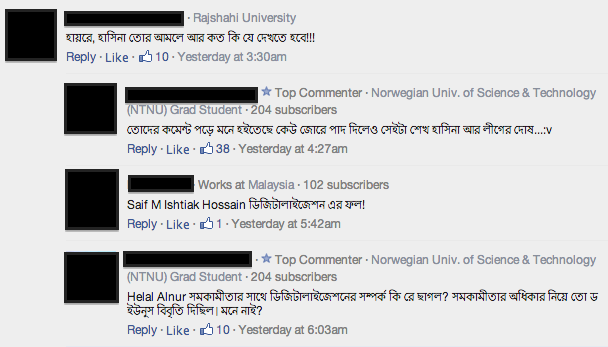
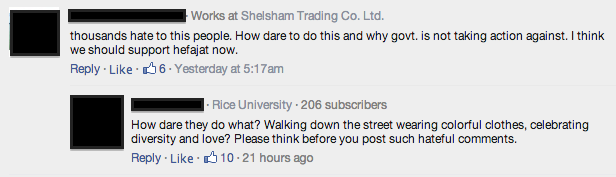
Every year on the 14th of April we celebrate Pahela Boishakh in Bangladesh. This year was no exception, except for the short rainbow themed rally that took place right after the main New Year's march. Bystanders may not have exactly understood the nature of the rally at the time, but people soon realised what it was given the later media reaction. Priyo.com published an article on the march, and people - just like the commenter above - have since been reacting on Facebook, Twitter and various blogs. A translation of the article can be read here.
Religion and Islam
![]() |
| As a queer Muslim one gets used to hearing the story of Prophet Lut |
Who are we to judge?
![]() |
| I'm glad this comment got so many likes |
The above is currently the comment with the second highest number of likes on the site, and hopefully in the future more people will think like this. The commenter asks who are we to judge whether this is good or bad, and why does it concern everyone so much. Picking out the Bengali parts of the comment, the commenter goes on to say that these men are are brave for standing up to the narrow minded people in our society.
The question of why does it bother others is the one that strikes me most. First of all, no LGBTQ person is going to really want to associate themselves closely with a homophobe. These people who should rest a little easier. My second issue, one that I see mirrored in other parts of the world, is what harm exactly do people think we're going to do to society? Living openly and loving our partners hardly seems like a precursor for the apocalypse.
![]() |
| শেষের প্রশ্নটা নিয়ে আসলেই আমাদের ভাবা উচিত - এত মাথা ঘামানোর কি আছে? |
Awami League is to blame for everything
![]() |
| It's a shame I have to translate this one, takes the punch out of the joke! |
![]() |
| Again, I'm pleased that the positive comment got more likes |
Comparisons with animals, addiction, peadophilia and incest
![]() |
| We've seen these comparisons our whole lives |
Threats of violence
![]() |
| What can I say to these? |
Conclusion?
মতামত: সমকামীদের প্রতি বাংলাদেশি মানুষের পতিক্রিয়া
|
| আমাদেরকে নাকি বোমা ফাটিয়ে মেরে ফেলা উচিত |
গত মঙ্গলবার ১৪ এপ্রিল আমরা ১৪২১ সালের পহেলা বৈশাখ উদজাপন করলাম, যেমন আমরা করি প্রতি বছর। কিন্তু এ বছর মঙ্গল শোভাযাত্রার পরে কিছু মানুষ রংধনুর রঙে রাঙানো ছোট্ট একটি মিছিল বের করেছিল। ঠিক ওই মুহুর্তে জনসাধারণ বুঝতে না পারলেও পরে সবাই ঠিক বুঝতে পারে যে এটা একটি 'সমকামী র্যালি' ছিল।এ নিয়ে priyo.com এ একটি লেখাও চাপা হয়েছে। এ লেখা, ফেসবুক, টুইটার ও বিভন্ন ব্লগে অনেক বাংলাদেশী মানুষের বিভিন্ন পতিক্রিয়া প্রকাশ হয়েছে - উপরের ছবির মানুষটির কমেন্টের মতন।
ধর্ম ও ইসলাম
![]() |
| মসুলমান হিসেবে আমার হজরত লুতের গল্প অনেক শুনতে হয় |
আমরা এদের বিচার করার কে?
![]() |
| এ কমেন্টার যে এতো লাইক তা দেখে আমি খুশি! |
![]() |
| শেষের প্রশ্নটা নিয়ে আসলেই আমাদের ভাবা উচিত - এত মাথা ঘামানোর কি আছে? |
সব আওয়ামী লীগের দোষ
![]() |
| খিক! |
![]() |
| কোন কমেন্টা বেশি লাইক পেয়েছে তাতে আমি একটু শান্তনা নিচ্ছি |
পশু ও 'শিশুকামীদের' সাথে তুলোনা
![]() |
| এ ধরনের তুলোনা আজীবন দেখে আসছি |
এবং ধরে মারো
![]() |
| কি বলব জানি না |